



Revenue diversification tops Gama’s agenda as he takes over from seconded Molefe

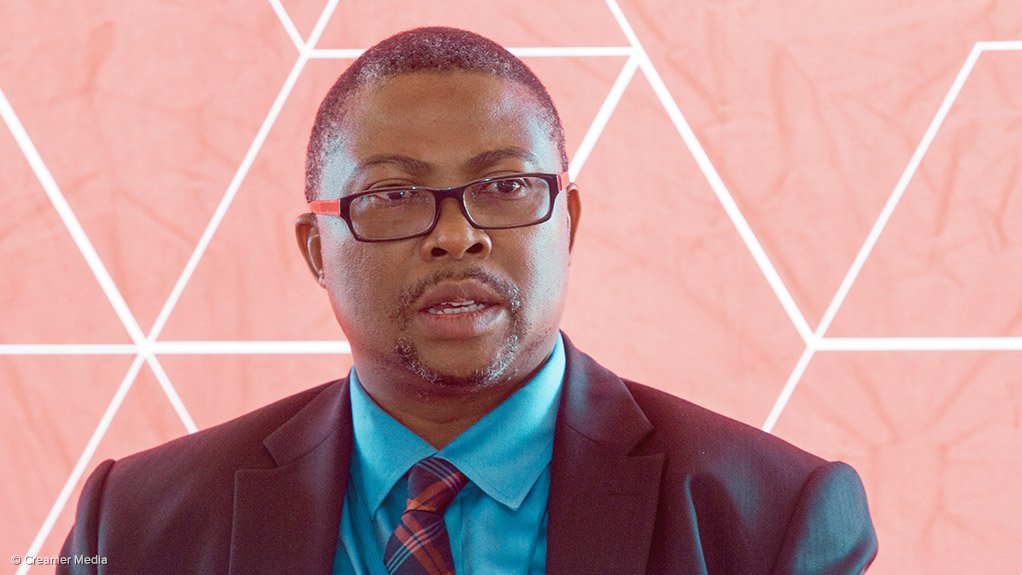



Acting Transnet CEO Siyabonga Gama, who was appointed to the position following the surprise secondment of Brian Molefe to Eskom, has placed revenue diversification at the top of his list of immediate priorities, with the weak commodity outlook seen as having the potential to undermine the State-owned company’s future prospects.
In an interview with Engineering News, Gama said Transnet’s current reliance on a few commodities, such as coal and iron-ore, had increased the urgency to implement the group’s road-to-rail strategy in noncommodity sectors. He also confirmed that seasoned railways man Ravi Nair, who had been overseeing the road-to-rail strategy, had been appointed acting CEO of Transnet Freight Rail (TFR) in his absence.
Officially, Molefe had been appointed to temporarily strengthen an Eskom executive team decimated since mid-March by the three-month suspension of four senior executives, including CEO Tshediso Matona.
But Public Enterprises Minister Lynne Brown had indicated that she expected Molefe to remain at Eskom for at least a year and possibly longer. For this reason, Gama stressed that both he and Nair had been given full authority over their respective portfolios and that both would seek to balance the longer-term imperatives of the R300-billion-plus Market Demand Strategy (MDS) with immediate pressures associated with the weak economic climate.
Gama emphasised that the MDS – the Molefe-inspired countercyclical investment plan aimed at rejuvenating and expanding the group’s infrastructure and rolling-stock assets ahead of demand – remained strongly intact and that he would continue to drive and consolidate it.
“But we are working in a context of very depressed commodity prices . . . and, as Transnet, we are reflecting on how this might affect us . . . for the longer term; we are convinced that we need to diversify our sources of revenue because we are probably too mining dependent,” Gama outlined.
The road-to-rail action plan was viewed as core to the diversification strategy, with Transnet keen to leverage its new, more reliable, rolling stock to raise container volumes and capture higher levels of market share in the transport of manufactured and fast-moving consumer goods.
Some recently acquired locomotives, meanwhile, would also be deployed to areas where service levels had been lagging. Gama revealed, for instance, that 28 new electric locomotives were set to be deployed to improve the services to ArcelorMittal South Africa, which had raised serious concerns about TFR’s recent reliability.
The larger rejuvenation of its rolling stock would continue in parallel with the four suppliers of 1 064 diesel and electric locomotives putting the final touches to their prototypes ahead of the July deadline, with CSR Zhuzhou Electric Locomotive having already delivered its prototype.
TFR, which had hitherto also focused primarily on the transport of import and export cargo, would now also pay closer attention to ‘point-to-point’ inland-market prospects – many of these opportunities would be pursued in alliance with other private logistics providers.
In the coming months, for instance, the utility would begin piloting a road-rail solution on the Cape and Natal corridors, whereby vehicles capable of operating both on rail tracks and on roads would be tested.
The aspiration was to improve the interchange between modes, as had been done in countries such as the US and Canada. Should it prove successful, Transnet would be looking to implement the technology more widely.
No Mds Scale-Back
Despite the economic headwinds, Gama stressed that there was no intention to scale back on the MDS investment programme, nor materially alter the associated funding plan. The intention was still to secure two-thirds of the funding from revenues generated by the group’s rail, ports and pipeline businesses and to finance the balance through borrowings, including through continued bond raising.
Notwithstanding the depressed commodities environment, Transnet had managed to grow its coal and iron-ore volumes in 2014/15. The group was yet to release figures for the full year, but, during the six months to the end of September, it reported that export coal volumes rose 4.3% to 43.7-million tons and that it still expected to rail 74.2-million tons for the full year. Iron-ore volumes rose 3% to 27.9-million tons, with R57.1-million budgeted for the full year.
In a bid to shore up future volumes and lower the risk associated with its large-scale investment programmes, TFR had migrated the iron-ore line across from yearly tariff negotiations to take-or-pay contracts, and Gama said it was on the cusp of concluding similar arrangements with all 36 of its coal customers.
The utility had hoped to conclude all the coal negotiations by the end of March, but Gama said only “governance processes” stood in the way of the final signatures and that he remained confident that the “last one or two” outstanding agreements would be concluded soon.
Mining group Glencore had strong reservations about the take-or-pay model, warning that such agreements could undermine security of coal supply to Eskom. However, Gama quipped that he hoped to be able to host a “gala dinner” in the not-too-distant future where he would thank the coal miners for their cooperation, following two years of tough negotiation.
He also remained optimistic about prospects for major coal-linked projects, saying that a final investment decision on the SwaziLink project, which would divert general freight off the coal export corridor and raise the Richards Bay line’s yearly capacity to close to 100-million tons, should be made by August. Studies were also progressing on ways to open up the Waterberg coalfields to export markets.
In both instances, funding plans would deviate from Transnet’s traditional model, with the Waterberg initiative likely to be implemented as a public–private partnership and with the SwaziLink project likely to be pursued under the aegis of a special-purpose vehicle, owned by Transnet and Swaziland Railways.
In taking over the reins at the 61 000-employee freight logistics group, Gama said he would continue to draw inspiration from Molefe’s tenure, which had been characterised by “bold” decision-making and a diligent execution of strategy.
“[Molefe] showed a lot of courage in saying that we should go for the MDS. He was always dedicated and committed to our cause . . . and did not turn back at the first sign of turbulence. He was always resilient, saying: ‘Guys, as long as we know that the strategy is the correct one . . . we must push ahead’,” Gama mused.
Article Enquiry
Email Article
Save Article
Feedback
To advertise email advertising@creamermedia.co.za or click here
Research Reports

Projects

Latest Multimedia
Latest News
Showroom

For over 60 years, VEGA has provided industry-leading products for the measurement of level, density, weight and pressure. As the inventor of the...
VISIT SHOWROOM
Announcements
What's On
Subscribe to improve your user experience...
Option 1 (equivalent of R125 a month):
Receive a weekly copy of Creamer Media's Engineering News & Mining Weekly magazine
(print copy for those in South Africa and e-magazine for those outside of South Africa)
Receive daily email newsletters
Access to full search results
Access archive of magazine back copies
Access to Projects in Progress
Access to ONE Research Report of your choice in PDF format
Option 2 (equivalent of R375 a month):
All benefits from Option 1
PLUS
Access to Creamer Media's Research Channel Africa for ALL Research Reports, in PDF format, on various industrial and mining sectors
including Electricity; Water; Energy Transition; Hydrogen; Roads, Rail and Ports; Coal; Gold; Platinum; Battery Metals; etc.
Already a subscriber?
Forgotten your password?
Receive weekly copy of Creamer Media's Engineering News & Mining Weekly magazine (print copy for those in South Africa and e-magazine for those outside of South Africa)
➕
Recieve daily email newsletters
➕
Access to full search results
➕
Access archive of magazine back copies
➕
Access to Projects in Progress
➕
Access to ONE Research Report of your choice in PDF format
RESEARCH CHANNEL AFRICA
R4500 (equivalent of R375 a month)
SUBSCRIBEAll benefits from Option 1
➕
Access to Creamer Media's Research Channel Africa for ALL Research Reports on various industrial and mining sectors, in PDF format, including on:
Electricity
➕
Water
➕
Energy Transition
➕
Hydrogen
➕
Roads, Rail and Ports
➕
Coal
➕
Gold
➕
Platinum
➕
Battery Metals
➕
etc.
Receive all benefits from Option 1 or Option 2 delivered to numerous people at your company
➕
Multiple User names and Passwords for simultaneous log-ins
➕
Intranet integration access to all in your organisation

