



Poorer South Africans carrying the can for SA’s lack of financial inclusion


This article has been supplied.
Paul Kent, MD of Sureswipe, says that South Africa needs a national financial inclusion strategy that has the commitment of all the dominant players in government and business, and that we should look at other emerging economies like India and Indonesia to see how it can be done.
The challenge of financial inclusion in South Africa is not the low numbers of bank card holders but rather the low numbers of payment acceptance points. There are around 80-million bank cards in circulation, yet usage within these accounts remains low. Many South Africans use their bank cards once a month to draw their full salary or grant. In urban suburbs bank cards are accepted for purchases almost everywhere but as you move into peri-urban or rural areas only one in ten retailers accept card payments.
It is no wonder that over 60% of all transactions in SA are conducted in cash and this increases to as much as 90% in rural areas where both informal retailers and low-income levels prevail. According to a study by Mastercard, the cost of cash in SA tops at R23-billion - 0.53% of GDP - and it is largely low-income earners that are carrying this cost.
According to the World Bank, financial inclusion means that “individuals and businesses have access to useful and affordable financial products and services that meet their needs – transactions, payments, savings, credit and insurance – delivered in a responsible and sustainable way.” This is not the case in SA at the moment, and, it is the indigent that are the most adversely affected by the way our financial services sector is currently structured. Financial technology or fintech companies have stepped in to change that, but the odds that they face as entrepreneurs are huge.
For Payment Service Providers (PSPs) like Sureswipe, which has been joined by newer fintech startups such as Yoco and iKhokha, the ability to access and service the informal sector at a price point that makes commercial sense has been one of the main business challenges. In SA expensive regulatory and compliance requirements make the costs of onboarding a new retailer far greater than the revenue earned on the transactions that the retailer makes every month. Though this changes as the retailer moves from startup to small business, the initial outlay is being carried by fintech providers.
Furthermore, access to the national payment system (NPS) is limited and PSPs still need to partner with one of the big financial institutions in order to operate. All this has done in SA is decrease both competition and product reliability and increase costs.
Interestingly, since the inception of card payment fintech players into the SA market, the increase in competition to incumbent banks has seen merchant discount (transaction) fees almost half, putting millions of Rands back into the pockets of independent retailers.
To ramp up financial inclusion in SA, we need to look at other emerging economies. The Indian and Indonesian governments introduced differentiated banking licenses to increase financial inclusion which have allowed smaller financial services companies to provide specific products and sometimes only in prescribed geographies.
This approach is more affordable for the fintech companies offering the service and provides a niched solution to a specific market. The Mexican government worked with its Chamber of Commerce and VISA to subsidise payment devices for informal retailers. About 20 000 devices were deployed, building more businesses, triggering sales and uplifting local economies.
Our government could step in on two fronts by introducing differentiated banking licenses and by driving more impactful public-private partnerships to quickly build a stronger SME sector.
Between Sureswipe, Yoco and iKhokha we have more than 40,000 payment devices in SA and we estimate that over 30,000 businesses are accepting card payments for the first time.
This year, Sureswipe marks its 10th year of existence. Yet in reaching this significant milestone, we have carried a lot of the risk ourselves by providing card payment services to businesses and independent retailers that would otherwise not have been able to afford them. Through our cash advance offering, we are also stepping in to provide loans that merchants would be hard-pressed to secure from the big banks. This is effectively access to working capital for merchants to expand or improve their businesses which is paid through customer card swipes.
Since 2010, more than 55 countries have made commitments to financial inclusion, and more than 30 have either launched or are developing a national strategy. Research by the World Bank has also shown that when countries institute a national financial inclusion strategy, they increase the pace and impact of reforms.
To expand financial inclusion in South Africa in a meaningful way, we need a dedicated national financial inclusion strategy that has the commitment of all the dominant players in government and business.
Article Enquiry
Email Article
Save Article
Feedback
To advertise email advertising@creamermedia.co.za or click here
Research Reports

Projects


Latest Multimedia


Latest News


Showroom
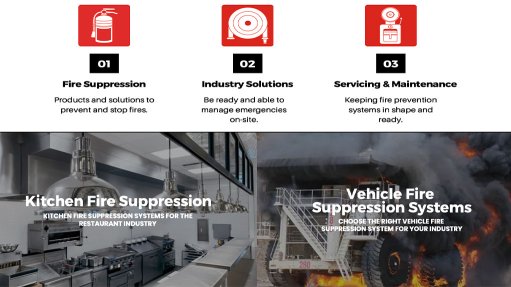
Established on 1 March, 2000, by Barries Barnard, Advanced Fire Suppression Technologies (AFST) and the Advanced Group stands as Sub-Saharan...
VISIT SHOWROOM
Virtual Gas Network supplies compressed natural gas via a virtual gas distribution network.
VISIT SHOWROOM


Announcements
What's On
Subscribe to improve your user experience...
Option 1 (equivalent of R125 a month):
Receive a weekly copy of Creamer Media's Engineering News & Mining Weekly magazine
(print copy for those in South Africa and e-magazine for those outside of South Africa)
Receive daily email newsletters
Access to full search results
Access archive of magazine back copies
Access to Projects in Progress
Access to ONE Research Report of your choice in PDF format
Option 2 (equivalent of R375 a month):
All benefits from Option 1
PLUS
Access to Creamer Media's Research Channel Africa for ALL Research Reports, in PDF format, on various industrial and mining sectors
including Electricity; Water; Energy Transition; Hydrogen; Roads, Rail and Ports; Coal; Gold; Platinum; Battery Metals; etc.
Already a subscriber?
Forgotten your password?
Receive weekly copy of Creamer Media's Engineering News & Mining Weekly magazine (print copy for those in South Africa and e-magazine for those outside of South Africa)
➕
Recieve daily email newsletters
➕
Access to full search results
➕
Access archive of magazine back copies
➕
Access to Projects in Progress
➕
Access to ONE Research Report of your choice in PDF format
RESEARCH CHANNEL AFRICA
R4500 (equivalent of R375 a month)
SUBSCRIBEAll benefits from Option 1
➕
Access to Creamer Media's Research Channel Africa for ALL Research Reports on various industrial and mining sectors, in PDF format, including on:
Electricity
➕
Water
➕
Energy Transition
➕
Hydrogen
➕
Roads, Rail and Ports
➕
Coal
➕
Gold
➕
Platinum
➕
Battery Metals
➕
etc.
Receive all benefits from Option 1 or Option 2 delivered to numerous people at your company
➕
Multiple User names and Passwords for simultaneous log-ins
➕
Intranet integration access to all in your organisation

