



Mboweni aims to slash spending by at least R150bn as fiscal risks rise

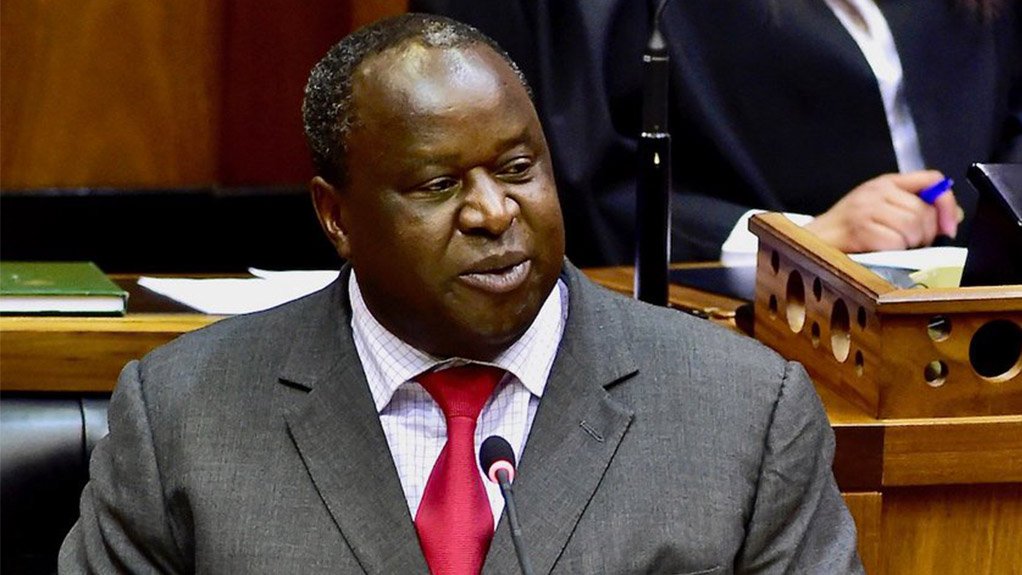


Finance Minister Tito Mboweni is aiming to slash expenditure by at least R150-billion over the coming three years, or R50-billion a year, as part of a plan to stabilise public finances and transition to a balanced primary Budget in 2022/23.
The Minister, who released the 2019 Medium-Term Budget Policy Statement (MTBPS) in Parliament last week, has indicated that the “sweet spot” for stablising the country’s finances would actually involve expenditure cuts of closer to R240-billion over the period, which would be difficult to achieve.
For this reason, he did not rule out the possibility of further tax increases and also hinted at the possibility of public-asset disposals to address the fiscal risks associated with the confirmation in the MTBPS of a shocking deterioration in the outlook for the Budget deficit, as well as the debt-to-gross domestic product (GDP) ratio.
“Our problem is that we spend more than we earn. It is as simple as that,” Mboweni told lawmakers in his address, adding that the short-term costs of the expenditure cuts were outweighed by the need to ensure sustainable public finances and intergenerational fairness.
To stabilise debt, government would target a primary balance, excluding the proposed further fiscal support for Eskom, by 2022/23 – a goal that would require revenue to equal noninterest expenditure in that year.
Spending reductions of R21-billion in 2020/21 and R29-billion in 2021/22 have already been identified, mostly in the areas of goods and services, and transfers.
Large additional adjustments, exceeding R150-billion over the three-year MTBPS period, would be required, however, and Mboweni said announcements regarding these further measures would be made in the 2020 Budget.
He also said that the National Treasury would engage with the Department of Public Enterprises on whether all the assets held by State-owned enterprises should be retained, arguing that it might be time to engage in some “basic portfolio management”.
The MTBPS document itself notes that the significant tax increases over the past several years leave only moderate scope to boost tax revenue. However, it also states that, given the size of the required adjustment, “additional tax measures are under consideration”.
The public-sector wage bill is another key area of focus, with the MTBPS stating that a decline in the growth of the public-service wage bill will be required to reduce the pressure on goods and services, and infrastructure. The wage bill accounted for 46% of tax revenue in 2019/20, primarily because of above- inflation increases in average remuneration over the past decade.
The document also states that, to reduce future transfers, a sustainable plan for State-owned companies is required, one that should include the disposal of noncore assets and options for private-sector participation.
Mboweni argued that failure to act to stablise the fiscal position would have grave consequences for South Africa, whose debt-to-GDP ratio would rise to 71.3% in 2022/23 in the absence of a move towards fiscal consolidation.
In 2019/20, the country’s debt-to-GDP ratio would already breach 60%, representing a material deterioration from the 56.2% level projected in February.
The rise to 60.8% is largely attributable to the additional support being provided for debt-laden power utility Eskom, which will receive transfers of R49-billion in 2019/20 and R56-billion in 2020/21.
The gross national debt will exceeded R3-trillion in 2019/20 and rise to R4.5-trillion in the next three years.
“Stabilisation involves difficult decisions that imply sacrifices by all of us. Slowing growth in the compensation bill and additional revenue measures will be needed,” Mboweni said.
Lower Growth
The Minister’s austerity proposal comes amid a deterioration in public finances since he delivered the 2019 Budget in February, as well as a downward revision to government’s growth and revenue collection forecasts.
The National Treasury has lowered its growth forecast for 2019 to 0.5% from the 1.5% guidance provided in February – the forecast is the lowest since the global financial crisis of 2008/9.
The outlook is also muted, with growth expected to recover to only 1.7% in 2022, supported by household consumption and private-sector investment.
Government expects to collect R1.37- trillion this year, R53-billion, or 4%, less than what was forecast in February.
The combination of lower revenue and increased spending widens the Budget deficit to 5.9% of GDP in the current year, and to an average of 6.2% over the next three years, peaking at 6.5% of GDP in 2020/21.
Mboweni also used the platform of his MTBPS address to release ‘Version 2’ of his growth strategy document, titled ‘Economic Transformation, Inclusive Growth and Competitiveness: Towards an Economic Strategy for South Africa’.
The document, which has been generally praised by business and slammed by labour, focuses primarily on several microeconomic reforms that could stimulate higher levels of growth and job creation.
Describing it as a “living document” rather than “dogma”, Mboweni said the document had given new life to the 2030 Vision contained in the National Development Plan.
Mboweni said progress had already been made in several areas, including the gazetting of an updated Integrated Resources Plan for electricity; preparations for the roll-out of the Infrastructure Fund; a simplification of the visa regime and abolition of the requirement on foreign tourists to present unabridged birth certificates; the upgrading of several industrial parks; and the Cabinet directive for the Independent Communications Authority of South Africa to accelerate the licensing of high-demand broadband spectrum.
“In our current context, growth-enhancing initiatives are very important,” Mboweni said, quipping that he did not mind being labelled a neoliberal, as long as the interventions taken were leading to growth.
Article Enquiry
Email Article
Save Article
Feedback
To advertise email advertising@creamermedia.co.za or click here
Research Reports

Projects

Latest Multimedia

Latest News
Showroom

Sweet-Orr, established in 1871, is a global leader in superior protective workwear, known for quality, innovation, and performance.
VISIT SHOWROOM
ESAB South Arica, the leading supplier of high-end welding and cutting products to the Southern African industrial market is based in...
VISIT SHOWROOM


Announcements
What's On
Subscribe to improve your user experience...
Option 1 (equivalent of R125 a month):
Receive a weekly copy of Creamer Media's Engineering News & Mining Weekly magazine
(print copy for those in South Africa and e-magazine for those outside of South Africa)
Receive daily email newsletters
Access to full search results
Access archive of magazine back copies
Access to Projects in Progress
Access to ONE Research Report of your choice in PDF format
Option 2 (equivalent of R375 a month):
All benefits from Option 1
PLUS
Access to Creamer Media's Research Channel Africa for ALL Research Reports, in PDF format, on various industrial and mining sectors
including Electricity; Water; Energy Transition; Hydrogen; Roads, Rail and Ports; Coal; Gold; Platinum; Battery Metals; etc.
Already a subscriber?
Forgotten your password?
Receive weekly copy of Creamer Media's Engineering News & Mining Weekly magazine (print copy for those in South Africa and e-magazine for those outside of South Africa)
➕
Recieve daily email newsletters
➕
Access to full search results
➕
Access archive of magazine back copies
➕
Access to Projects in Progress
➕
Access to ONE Research Report of your choice in PDF format
RESEARCH CHANNEL AFRICA
R4500 (equivalent of R375 a month)
SUBSCRIBEAll benefits from Option 1
➕
Access to Creamer Media's Research Channel Africa for ALL Research Reports on various industrial and mining sectors, in PDF format, including on:
Electricity
➕
Water
➕
Energy Transition
➕
Hydrogen
➕
Roads, Rail and Ports
➕
Coal
➕
Gold
➕
Platinum
➕
Battery Metals
➕
etc.
Receive all benefits from Option 1 or Option 2 delivered to numerous people at your company
➕
Multiple User names and Passwords for simultaneous log-ins
➕
Intranet integration access to all in your organisation

