



Covid-19 Patients’ Lives Saved By 3d Printed Valves For Resuscitation Devices By Italian Hospital



This article has been supplied.
The supply chain was broken, people and 3D printing rose to the occasion
What will the implications be of the current COVID-19 pandemic on additive manufacturing?
No definite answers can be given yet. The relationship between COVID-19 and 3D printing is not yet entirely clear, mostly because we are far from understanding what the long, medium and even the short-term implications are going to be on global supply chains.
Additive manufacturing may be able to play a role in helping to support industrial supply chains that are affected by limitations on traditional production and imports. One thing is for sure though: 3D printing can have an immediate beneficial effect when the supply chain is completely broken. That was, fortunately, the case when a Northern Italian hospital needed a replacement valve for a resuscitation device and the supplier had run out with no way to get more in a short time.
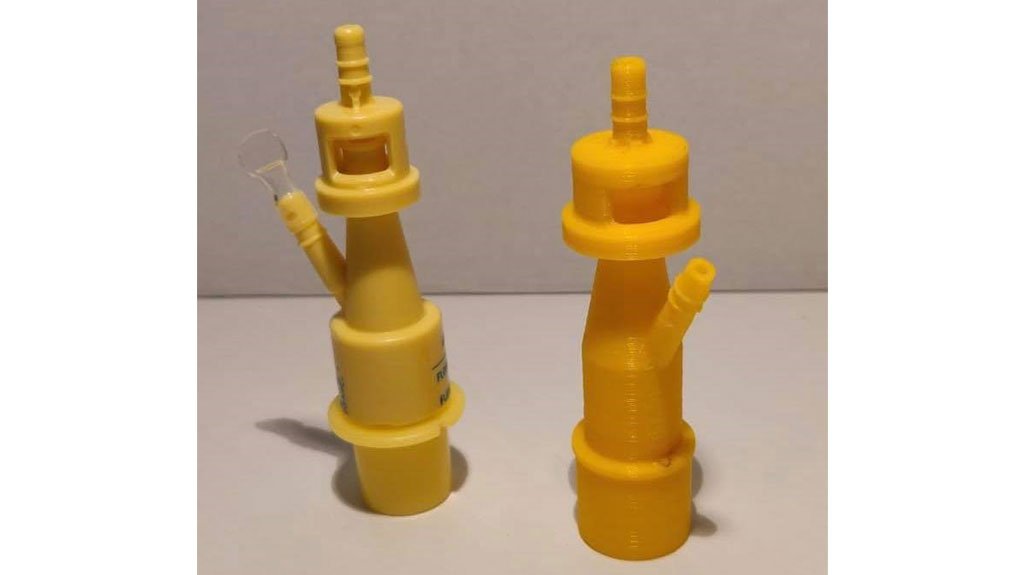
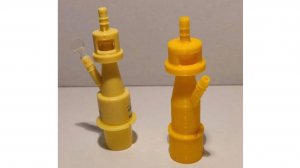
The original valve (on the left) and its 3D printed twin.
One of the biggest immediate problems that coronavirus is causing is the massive number of people who require intensive care and oxygenation in order to live through the infection long enough for their antibodies to fight it. This means that the only way to save lives at this point – beyond prevention – is to have as many working resuscitation machines as possible. And when they break down, maybe 3D printing can help.
Massimo Temporelli, founder of The FabLab in Milan and a very active and popular promoter of Industry 4.0 and 3D printing in Italy, reported early on Friday 13th that he was contacted by Nunzia Vallini, editor of the Giornale di Brescia, with whom he has been collaborating for several years for the dissemination of Industry 4.0 culture in schools.
She explained that the hospital in Brescia (near one of the hardest-hit regions for coronavirus infections) urgently needed valves (in the photo) for an intensive care device and that the supplier could not provide them in a short time. Running out of the valves would have been dramatic and some people might have lost their lives. So, she asked if it would be possible to 3D print them.
The device in question is a Venturi valve, used for a Venturi Oxygen mask. These are low-flow masks that use the Bernoulli principle to entrain room air when pure oxygen is delivered through a small orifice, resulting in a large total flow at predictable FIO2.
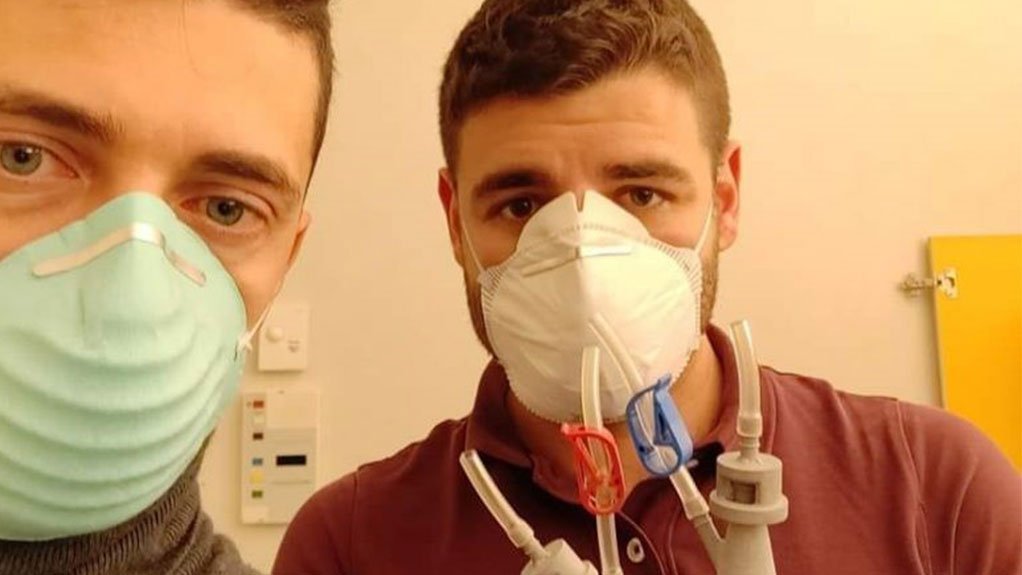
After several phone calls to FabLab and companies in Milan and Brescia and then, fortunately, a company in the area, Isinnova, responded to this call for help through its Founder & CEO Cristian Fracassi, who brought a 3D printer directly to the hospital and, in just a few hours, redesigned and then produced the missing piece.
On the evening of Saturday 14th (the next day) Massimo reported that “the system works”. At the time of writing, 10 patients are accompanied in breathing by a machine that uses a 3D printed valve. As the virus inevitably continues to spread worldwide and breaks supply chains, 3D printers – through people’s ingenuity and design abilities – can truly lend a helping hand. Whether you need a valve, protective gear, masks, or anything else that you cannot get from your usual supplier at this time.
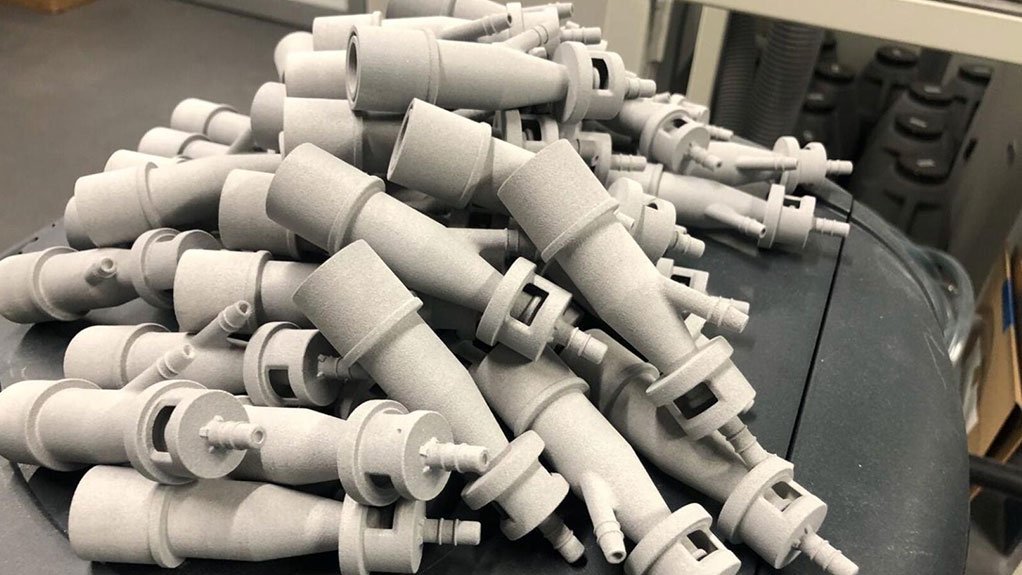
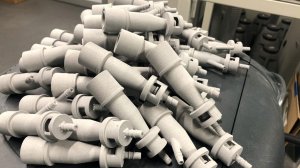
After the first valves were 3D printed using a filament extrusion system, on location at the hospital, more valves were later 3D printed by another local firm, Lonati SpA, using a polymer laser powder bed fusion process (photo below).
More valves were printed by Lonati SpA using a polymer laser powder bed fusion process.
So many have reached out to offer help in producing these parts, both local to Italy as well as globally. As far as public understanding goes, the model for the valve remains covered by copyright and patents. Hospitals may have a right to produce these parts in an emergency (as in this case) but, in order to legally obtain a 3D printable STL file, the hospital that requires the parts needs to present an official request.
Article Enquiry
Email Article
Save Article
Feedback
To advertise email advertising@creamermedia.co.za or click here
Research Reports

Projects
Latest Multimedia

Latest News

Showroom
Sweet-Orr, established in 1871, is a global leader in superior protective workwear, known for quality, innovation, and performance.
VISIT SHOWROOM
From batteries for boats and jet skis, to batteries for cars and quad bikes, SABAT Batteries has positioned itself as the lifestyle battery of...
VISIT SHOWROOM

Press Office
Announcements
What's On
Subscribe to improve your user experience...
Option 1 (equivalent of R125 a month):
Receive a weekly copy of Creamer Media's Engineering News & Mining Weekly magazine
(print copy for those in South Africa and e-magazine for those outside of South Africa)
Receive daily email newsletters
Access to full search results
Access archive of magazine back copies
Access to Projects in Progress
Access to ONE Research Report of your choice in PDF format
Option 2 (equivalent of R375 a month):
All benefits from Option 1
PLUS
Access to Creamer Media's Research Channel Africa for ALL Research Reports, in PDF format, on various industrial and mining sectors
including Electricity; Water; Energy Transition; Hydrogen; Roads, Rail and Ports; Coal; Gold; Platinum; Battery Metals; etc.
Already a subscriber?
Forgotten your password?
Receive weekly copy of Creamer Media's Engineering News & Mining Weekly magazine (print copy for those in South Africa and e-magazine for those outside of South Africa)
➕
Recieve daily email newsletters
➕
Access to full search results
➕
Access archive of magazine back copies
➕
Access to Projects in Progress
➕
Access to ONE Research Report of your choice in PDF format
RESEARCH CHANNEL AFRICA
R4500 (equivalent of R375 a month)
SUBSCRIBEAll benefits from Option 1
➕
Access to Creamer Media's Research Channel Africa for ALL Research Reports on various industrial and mining sectors, in PDF format, including on:
Electricity
➕
Water
➕
Energy Transition
➕
Hydrogen
➕
Roads, Rail and Ports
➕
Coal
➕
Gold
➕
Platinum
➕
Battery Metals
➕
etc.
Receive all benefits from Option 1 or Option 2 delivered to numerous people at your company
➕
Multiple User names and Passwords for simultaneous log-ins
➕
Intranet integration access to all in your organisation

