



Company Annoucements:Institute For Municipal Engineering Of Southern Africa Imesa Appeals To Municipal Engineers To Implement Stricter Road Safety Interventions In A Bid To Reduce Road Fatalities


This article has been supplied.
Worrying statistics recently released by the World Health Organisation (WHO) indicate that the African continent has the highest annual road traffic deaths per 100 000 population in the world.
According to the Global Status Report on Road Safety 2013, a total of 88 countries have reduced their road traffic deaths between 2007 and 2010; however, the global total of 1.24 million deaths per year remains unacceptably high. If you compare the overall road deaths in Africa, South Africa is not faring well. With an annual total of 31.9 road fatalities per 100 000, South Africa is the second highest killer of road users in Africa, following shortly after Nigeria at 33.7. Overall, there are large disparities in road traffic death rates between regions and per country income. The African average per 100 000 population is 24.1. The lowest recorded average in the European Union is only 10.3.
The effect of rapid motorisation has put the African continent in disequilibrium, increasing the risk of dying as a result of a road traffic injury.“The WHO report gives an indication of how serious the issue of road safety is in South Africa,” says Hilton Vorster, a director of traffic engineering at the transport department at the City of Tshwane.“More disconcerting about the WHO report is the fact that half of all recorded traffic deaths are amongst vulnerable road users: pedestrians, cyclists, and motorcyclists. Progress has been made in high-income countries; however, the greatest need lies with low- and medium income countries where little money is spent and deaths remain unacceptably high,” notes Vorster. “According to the report, of the 88 countries that improved their road safety statistics, 42 are high-income countries, 41 are middle-income, and only five falls in low-income countries.”
Vorster recently flagged these statistics at a branch meeting held by the Institute of Municipal Engineers of Southern Africa (IMESA) in Pretoria, where he appealed to the audience - a constituency of IMESA members, predominantly municipal engineers - to take responsibility for traffic-related injury through improved engineering intervention.
He imparts that the media often refers to the causes of road deaths in terms of negligent drivers or non-roadworthy vehicles. “News reports rarely reflect on the impact of hard engineering elements as a potential cause for road incidents”. According to the Road Traffic Management Corporation, 85% of accidents occur due to human factor. “This statistic may give the impression that we must only focus on the human side of road safety management, through law enforcement and education; but there is a serious lack in recognising the importance of safe infrastructure and road maintenance to prevent accidents.” Vorster emphasises that traffic engineers should therefore make allowance that will help compensate for human error. “Roads and roadsides must be built in such a way that the physical infrastructure, signage and speed control interventions reduce the risk of road accidents”
“There are various engineering interventions municipalities can undertake to reduce road accidents. Through the ‘safe system approach’ roadsides should be built in such a way that their physical characteristics minimise potential harmful consequences. It includes speed management measures in road infrastructure projects, such as the implementation of traffic calming interventions”. He cites a statistic that a pedestrian has a reasonable chance of survival at an impact of 30 km/h but as soon as the speed increases to 60 km/h, the chance for survival becomes less than 20%. Traffic calming measures are of critical importance, notes Vorster. “New projects need to be checked to ensure that implementation will meet safety standards. Already, 140 countries, a total of 77%, carry out some type of road safety audit on new road infrastructure projects. Existing road infrastructure should also be assessed for safety at regular intervals, with a focus on roads that have the highest crash risks,” Vorster informs. “In 2010, the United Nations General Assembly and governments across the world declared the years 2011 to 2020 as the Decade of Action for Road Safety. It is 3 Prepared on behalf of the Institute of Municipal Engineering of South Africa (IMESA) on 25 July 2013
imperative that South African municipalities join in to reduce its global road safety statistics, and commit themselves to infrastructure management and road maintenance that will make South African roads a safer place for drivers, cyclists and pedestrians,” says Pieter Myburgh, IMESA’s technical director of roads, transportation and storm water.
“As the Institute of Municipal Engineers of Southern Africa we support our members through advocacy, information sharing and capacity building to improve the conditions of South African roads, through engineering excellence,” he concludes.
Article Enquiry
Email Article
Save Article
Feedback
To advertise email advertising@creamermedia.co.za or click here
Research Reports

Projects

Latest Multimedia

Latest News

Showroom
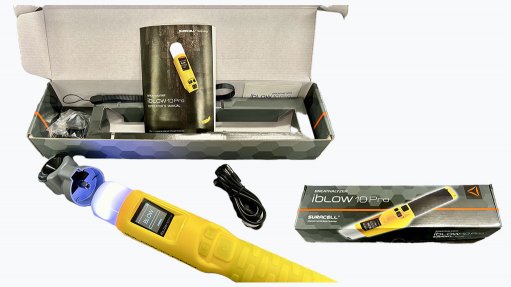
Supplier & Distributor of the Widest Range of Accurate & Easy-to-Use Alcohol Breathalysers
VISIT SHOWROOM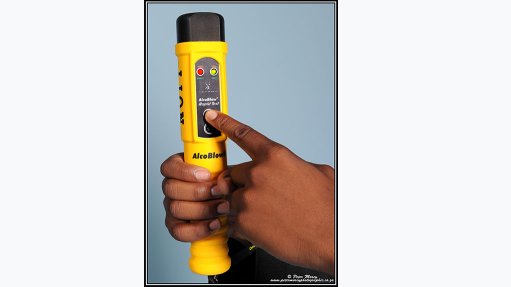
Developed to exceed the latest EN 15964 standards for police breathalysers proving that it will remain accurate and reliable for many years to come.
VISIT SHOWROOM

Announcements
What's On
Subscribe to improve your user experience...
Option 1 (equivalent of R125 a month):
Receive a weekly copy of Creamer Media's Engineering News & Mining Weekly magazine
(print copy for those in South Africa and e-magazine for those outside of South Africa)
Receive daily email newsletters
Access to full search results
Access archive of magazine back copies
Access to Projects in Progress
Access to ONE Research Report of your choice in PDF format
Option 2 (equivalent of R375 a month):
All benefits from Option 1
PLUS
Access to Creamer Media's Research Channel Africa for ALL Research Reports, in PDF format, on various industrial and mining sectors
including Electricity; Water; Energy Transition; Hydrogen; Roads, Rail and Ports; Coal; Gold; Platinum; Battery Metals; etc.
Already a subscriber?
Forgotten your password?
Receive weekly copy of Creamer Media's Engineering News & Mining Weekly magazine (print copy for those in South Africa and e-magazine for those outside of South Africa)
➕
Recieve daily email newsletters
➕
Access to full search results
➕
Access archive of magazine back copies
➕
Access to Projects in Progress
➕
Access to ONE Research Report of your choice in PDF format
RESEARCH CHANNEL AFRICA
R4500 (equivalent of R375 a month)
SUBSCRIBEAll benefits from Option 1
➕
Access to Creamer Media's Research Channel Africa for ALL Research Reports on various industrial and mining sectors, in PDF format, including on:
Electricity
➕
Water
➕
Energy Transition
➕
Hydrogen
➕
Roads, Rail and Ports
➕
Coal
➕
Gold
➕
Platinum
➕
Battery Metals
➕
etc.
Receive all benefits from Option 1 or Option 2 delivered to numerous people at your company
➕
Multiple User names and Passwords for simultaneous log-ins
➕
Intranet integration access to all in your organisation

