Advances in coal dust testing support safety compliance


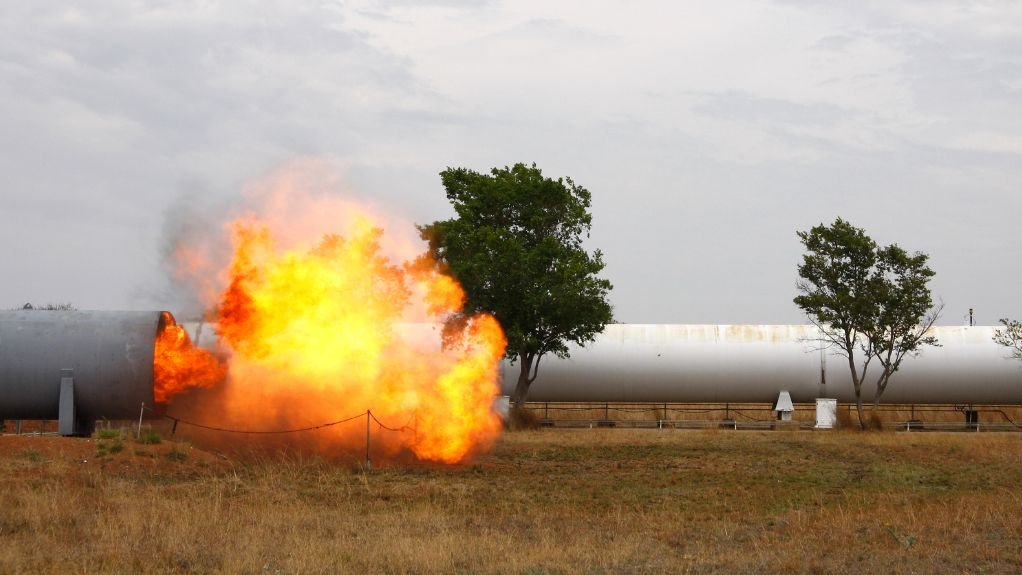
RIAAN BERGH Coal dust explosibility testing at Kloppersbos is now more accurate using a modern international-standard testing system, but mine-specific environmental conditions need careful monitoring
STANDARDISED TESTING Kloppersbos now operates a 20 ℓ explosion vessel, which is recognised internationally as a standard for dust explosibility testing and can be independently calibrated through yearly testing administered by the equipment manufacturer



Research conducted by national research institution the Council for Scientific and Industrial Research (CSIR) has demonstrated that coal dust explosibility testing can be performed using a modern international-standard testing system when accounting for mine-specific environmental conditions.
Speaking at the Coaltech Colloquium, held on May 28 in Benoni, at the Anew Hotel and Conference Centre, CSIR mechanical engineer Riaan Bergh said the organisation’s Kloppersbos facility was established about 40 years ago to help protect South Africa’s coal mining industry from large-scale coal dust and methane explosions.
A critical aspect of managing explosion risk is understanding whether coal dust generated at a mine is capable of propagating an explosion.
“If you know the nature of your coal and you know that it is possible for that coal dust to propagate an explosion, you can take appropriate mitigating steps,” he said.
Coal dust explosibility testing at Kloppersbos has historically been conducted using a 40 ℓ explosion vessel. However, while classification limits for explosibility were developed using this equipment, the facility has not been able to independently verify the accuracy of the testing results for a significant period.
Kloppersbos now operates a 20 ℓ explosion vessel, which is recognised internationally as a standard for dust explosibility testing and can be independently calibrated through yearly testing administered by the equipment manufacturer.
“The challenge was that no relationship had previously been established between the results obtained from the older 40 ℓ vessel and those generated by the newer 20 ℓ apparatus,” he explained.
In addition, laboratory testing is conducted under controlled conditions of about 22 °C, relative humidity of about 45%, and in the absence of methane – conditions that differ from those encountered underground.
To address these challenges, the CSIR conducted a literature review of historical South African research and international dust explosibility testing practices, in addition to collecting coal samples from 16 local underground mines in South Africa and testing them using both systems.
The research also explored the influence of temperature, humidity and methane on coal dust explosibility.
The study established an acceptable relationship between the results obtained from the two testing systems, allowing for historical data generated using the 40 ℓ vessel to be translated into results generated by the 20 ℓ apparatus.
“This enables coal dust classification limits developed using the older equipment to be expressed using the parameters generated by the newer system,” he said.
The study also explored the effects that temperature and humidity had on coal dust explosibility, finding these moderately impacted on coal dust explosibility, while methane had a significantly greater effect.
Bergh also explained that increasing temperatures tended to increase explosibility, while increasing humidity reduced it slightly, but noted that a 1% increase in methane concentration could increase the explosibility index by 22 bar per second.
The difference between coal dust classified as safe and coal dust classified as hazardous is only 25 units, demonstrating the significant influence methane can have on explosion risk.
The combined effect of temperature, humidity and methane can, thus, alter the classification of coal dust from safe to transitional or hazardous conditions.
Bergh, therefore, recommended that laboratory test results be adjusted to reflect actual mine conditions.
“When you receive the result at your mine, you need to ask your mine ventilation control team: what are the temperature conditions at the moment, what is the humidity reading, and what is the methane that we are measuring, so that you can adjust it and then decide whether your explosion control measures are appropriate.”
Bergh said mining companies should regularly sample coal dust and have it tested by the CSIR to understand its characteristics and update standard operating procedures accordingly.
He also recommended continuous monitoring of temperature, humidity and methane, coupled with automated calculations and alerts that indicate when conditions shift from safe to transitional or unsafe classifications.
Further, he stressed the importance of incorporating methane dilution requirements into mine planning and ventilation design.
Concluding the presentation, Bergh said the research confirmed that coal dust explosibility can be tested using the 20 ℓ vessel and that results should be adjusted to account for actual underground atmospheric conditions. Regular testing and monitoring would also provide mining operations with a more accurate assessment of explosion risks and support the implementation of appropriate control measures.
Article Enquiry
Email Article
Save Article
Feedback
To advertise email advertising@creamermedia.co.za or click here
Research Reports


Projects
Latest Multimedia

Latest News
Showroom

Iritron delivers advanced automation, control, and optimisation solutions to the Mining, Minerals & Metals, Consumer Package Goods and...
VISIT SHOWROOM
At Airshrink - CiP, we surpass customer expectations with innovative MV and LV cable accessories, including heat shrink joints, terminations,...
VISIT SHOWROOM


Press Office
Announcements
What's On
Subscribe to improve your user experience...
Option 1 (equivalent of R125 a month):
Receive a weekly copy of Creamer Media's Engineering News & Mining Weekly magazine
(print copy for those in South Africa and e-magazine for those outside of South Africa)
Receive daily email newsletters
Access to full search results
Access archive of magazine back copies
Access to Projects in Progress
Access to ONE Research Report of your choice in PDF format
Option 2 (equivalent of R375 a month):
All benefits from Option 1
PLUS
Access to Creamer Media's Research Channel Africa for ALL Research Reports, in PDF format, on various industrial and mining sectors
including Electricity; Water; Energy Transition; Hydrogen; Roads, Rail and Ports; Coal; Gold; Platinum; Battery Metals; etc.
Already a subscriber?
Forgotten your password?
Receive weekly copy of Creamer Media's Engineering News & Mining Weekly magazine (print copy for those in South Africa and e-magazine for those outside of South Africa)
➕
Recieve daily email newsletters
➕
Access to full search results
➕
Access archive of magazine back copies
➕
Access to Projects in Progress
➕
Access to ONE Research Report of your choice in PDF format
RESEARCH CHANNEL AFRICA
R4500 (equivalent of R375 a month)
SUBSCRIBEAll benefits from Option 1
➕
Access to Creamer Media's Research Channel Africa for ALL Research Reports on various industrial and mining sectors, in PDF format, including on:
Electricity
➕
Water
➕
Energy Transition
➕
Hydrogen
➕
Roads, Rail and Ports
➕
Coal
➕
Gold
➕
Platinum
➕
Battery Metals
➕
etc.
Receive all benefits from Option 1 or Option 2 delivered to numerous people at your company
➕
Multiple User names and Passwords for simultaneous log-ins
➕
Intranet integration access to all in your organisation