Anglo’s polyhalite entry likely to hit MoP more than SoP – Danakali


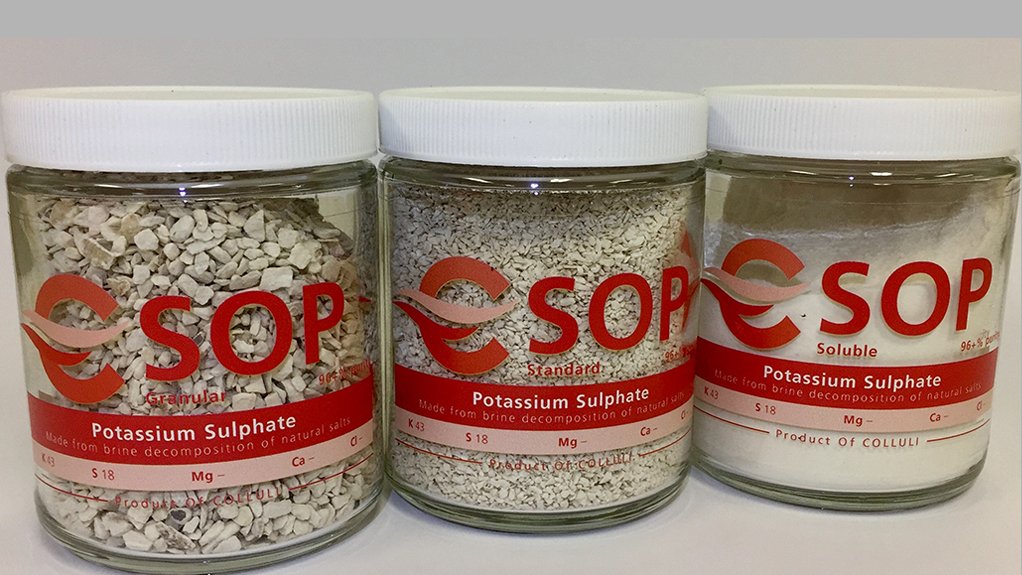



The proposed entry of Anglo American into the fertiliser industry is more likely to impact the muriate of potash (MoP) market than the sulphur of potash (SoP) market, says Danakali CEO Niels Wage.
MoP production is relatively concentrated, with single-channel CanPotex group of companies in Canada and Russian producers commanding 60% of the market.
Wage spoke to Engineering News & Mining Weekly against his background of at one stage being responsible for the commercial aspects of BHP’s stalled potash project in Canada.
Having worked for thirteen-and-a-half years looking after the market for the Jansen MoP development in Saskatchewan, Wage now heads the Sydney- and London-listed Danakali company, which is developing the Colluli SoP project, in Eritrea, where it is in 50:50 joint venture with the State-owned Eritrean National Mining Corporation.
A firm believer in the positive crop-yield improvement fertilisers make in today’s world of diminishing arable land and growing global population, Wage says the fundamentals of the fertiliser industry remain sound.
“We expect demand for potash to pick up again,” he says.
The multinutrient polyhalite-based Poly4 product that Anglo is setting out to acquire from Sirius is currently on the lowest rung of the price ladder, compared with MoP and SoP.
But it is also at the lowest end of the cost curve. In addition, polyhalite has the advantage of being produced in an environment-friendly manner, emitting 89% less carbon dioxide (CO2) than MoP and 93% less CO2 than SoP when processed.
But Poly4 will be up against products that are well entrenched in the marketplace. Global demand for MoP is between 65-million tons and 70-million tons a year and global demand for SoP is some seven-million tons a year.
SoP sells at $500/t, MoP at $275/t and Poly4, when the prices of individual polyhalite elements are combined into a single basket price, at $200/t – but with costs at a potential rock-bottom $40/t to $50/t.
Containing potassium, sulphur, magnesium and calcium, Poly4 is said to be particularly valuable for crop such as tea, coffee, beans, potatoes and many fruits and vegetables.
“It’s not intended that this will be a wholesale substitute for one of the potash fertilisers today. We think that it’s likely to coexist with those today. What’s important in all of this, and what makes it extremely attractive for us, is where it would fit on the cost curve,” said Wanblad.
In addition to the niobium and phosphate assets it owned until four years ago in Brazil, Anglo also once obtained insight into polyhalite through its association with the Boulby potash mine next to Sirius’s Woodsmith operation, in North Yorkshire, UK.
Wage emphasised the importance of the potash content of fertiliser products to the agricultural market.
“Clearly, potash content – the potassium oxide (K2O) – is very important for farming. SoP is 52% K2O and Poly4 only 14% K2O. If you need potassium content on your crops, you need to apply Poly4 three times for one time of SoP.
“Key to our SoP product is that it’s virtually chloride free. It has a chloride content of less than 0.2%, whereas Poly4 has a chloride content of 3%. If you apply that three times, you have 9% chloride, which makes it not that suitable for the fruit and vegetables affected by chloride,” says Wage.
“But, there again, you need to apply a lot more to get the same K2O potash content for the farmer. MoP can improve crop yield by 2.5% to 3% and SoP by an even higher percentage in some areas. You have to apply a lot of polyhalite to get the same impact.
“For some crops, that won’t be an issue. Farmers will accept it if it’s cheap enough. But I don’t think it’s going to be a significant competitor for especially SoP, because it’s just too high in chloride and its sulphur content is 19%, compared with SoP’s 8.5%,” he adds.
Danakali, which is targeting the primary production of SoP from the brine in evaporation ponds, has secured credit approval for a $200-million senior debt facility from the Africa Finance Corporation and African Export Import Bank, which is the bulk of the finance required for construction and project execution of the $302-million project.
Stage 1 of the fully permitted Colluli project will have the capacity to produce 472 000 t/y of SoP.
“There is a lot of activity going on. We expect execution to production to take 24 to 27 months,” says Wage.
Swiss-based fertiliser company EuroChem has agreed to take off everything Danakali produces for ten years, with an option for three more.
“It’s good to have an organisation like that behind us,” says Wage.
Johannesburg project house DRA, the engineering, procurement, construction and management contractor, is working with Danakali to update the numbers as the project gets ready for its construction phase. Production is expected from 2022.
Colluli, located 75 km from the Red Sea coast, is amenable to opencast mining.
BHP made its blocked bid for Potash Corporation ten years ago, when potash tended to go little noticed outside Canada. But BHP caused the potash price to soar, which resulted in new entrants with an eye on producing at a cost of $100/t and selling at a price of $860/t.
But additional production has resulted in prices falling well below the expected level.
BHP will now only decide on its long-delayed $17-billion Jansen potash project by February 2021, after having spent nearly $3-billion on laying the groundwork and sinking two shafts.
In October, BHP approved $345- million for engineering to support project planning, a port solution and the mine’s scope of work, but another $5.3-billion to $5.7-billion will be required to finish the mine’s first phase alone.
BHP says it can produce MoP for about $100/t, but some of its shareholders have questioned the logic of adding more supply to what they say is an already saturated fertiliser market.
Consolidation is being advocated in some circles to optimise costs and production. •
See also page 10Article Enquiry
Email Article
Save Article
Feedback
To advertise email advertising@creamermedia.co.za or click here


Projects


Latest Multimedia

Latest News

Showroom

Rooted in the hearts of South Africans, combining technology and a quest for perfection to bring you a battery of peerless standing. Willard...
VISIT SHOWROOM
The Beneficiation Academy is a certified training institution that follows all compliance legislation and is accredited with various Sector...
VISIT SHOWROOM



Press Office
Announcements
What's On
Subscribe to improve your user experience...
Option 1 (equivalent of R125 a month):
Receive a weekly copy of Creamer Media's Engineering News & Mining Weekly magazine
(print copy for those in South Africa and e-magazine for those outside of South Africa)
Receive daily email newsletters
Access to full search results
Access archive of magazine back copies
Access to Projects in Progress
Access to ONE Research Report of your choice in PDF format
Option 2 (equivalent of R375 a month):
All benefits from Option 1
PLUS
Access to Creamer Media's Research Channel Africa for ALL Research Reports, in PDF format, on various industrial and mining sectors
including Electricity; Water; Energy Transition; Hydrogen; Roads, Rail and Ports; Coal; Gold; Platinum; Battery Metals; etc.
Already a subscriber?
Forgotten your password?
Receive weekly copy of Creamer Media's Engineering News & Mining Weekly magazine (print copy for those in South Africa and e-magazine for those outside of South Africa)
➕
Recieve daily email newsletters
➕
Access to full search results
➕
Access archive of magazine back copies
➕
Access to Projects in Progress
➕
Access to ONE Research Report of your choice in PDF format
RESEARCH CHANNEL AFRICA
R4500 (equivalent of R375 a month)
SUBSCRIBEAll benefits from Option 1
➕
Access to Creamer Media's Research Channel Africa for ALL Research Reports on various industrial and mining sectors, in PDF format, including on:
Electricity
➕
Water
➕
Energy Transition
➕
Hydrogen
➕
Roads, Rail and Ports
➕
Coal
➕
Gold
➕
Platinum
➕
Battery Metals
➕
etc.
Receive all benefits from Option 1 or Option 2 delivered to numerous people at your company
➕
Multiple User names and Passwords for simultaneous log-ins
➕
Intranet integration access to all in your organisation