Creamer Media’s Mining Weekly Online
Mining Weekly Magazine Cover
Magazine in Store Now!
Advanced Search
 
 
powered by
GOLD 1074.91 $/ozChange: 9.90
PLATINUM 1499.00 $/ozChange: 19.00
R/$ exchange 7.73Change: 0.00
R/€ exchange 10.60Change: -0.02
 
 
DIAMONDS
Diamond juniors must merge to stay on the map – Rockwell chief
0 COMMENTS  |  
ADD A COMMENT PRINT
 
 
6th March 2009
TEXT SIZE
Text Smaller Disabled Text Bigger
 

TORONTO (miningweekly.com) – The diamond industry will go through a period of “consolidation and rationalisation” over the next year or so, and small producers must consider merger and acquisition activity if they want to survive the pruning, said Rockwell Diamonds CEO John Bristow.

Vancouver-based Rockwell produces high-value diamonds from alluvial mines in South Africa.

The company has had approaches from other juniors, and is talking to potential partners, Bristow said in an interview in Toronto on Thursday.

There is a lot more pragmatism in the market, and companies are prepared to talk to each other to find ways to create value, he commented.

There is especially pressure on junior producers, the market capitalisations of which have shrunk to the point where they are no longer on the radar for many investors.

“People lose interest, it's just too small,” Bristow said.

“So, we are very firmly of the view that there needs to be consolidation in this market.”

Earlier this week, Gryphon Partners managing partner Gordon Bogden told an audience at the Prospectors and Developers Association of Canada conference that many junior and smaller midtier companies will need to consider mergers if they are to survive the difficult economic climate.

Rockwell will firstly consider tieups with diamond miners which have alluvial operations in South Africa, although it might consider looking further north, to countries like Angola and the Democratic Republic of Congo, as well as to West Africa, he said.

Although any transaction would of necessity be paper-based, Rockwell is considering a private placement – probably of at least C$5-million, to cover things like lawyers' and advisers' fees for a potential deal.

The financing would also provide an additional cushion in case the market dips further, Bristow said, although he emphasised that the firm, which has between C$4-million and C$5-million on hand including inventory, is by no means in distress.

“But it is going to be a challenging year,” he added.

“There will be consolidation in the industry and the business; a lot of weak players, be they miners, be they beneficiators, be they retail stores, will certainly disappear.”

While the long-term forecast of a shortage of gem-quality rough diamonds appeared intact, the next year or two will remain "challenging", RBC Capital Markets analyst Des Kilalea predicted in a research note on the industry this week.

"Industry operators are feeling the pinch of lower sales volumes and lower prices, with most companies now in 'cash preservation' mode," he commented.

The diamond market had an exceptionally strong first three quarters of 2008, but in October, November and December trade ground to a standstill as a market surplus and slowing economic activity translated into severely depressed sales, said Rockwell marketing and sales manager Jeffrey Brenner.

By now, however, any oversupply in the market has been cleared out into the retail sector, after diamond miners slashed output levels, and the wheels of trade have begun to turn again.

Rockwell, with its high-value gems, has not been as hard-hit by price declines as some other producers, Brenner said.

Overall, prices for the company's diamonds have probably declined by about 30% to 40% from last year's values.

In response to the market downturn at the tail end of 2008, the company opted to extend its Christmas shutdown period, and kept its mines closed for the duration of December and January.

In February, it restarted the Holpan, Klipdam and Saxendrift operations, but decided to put the Wouterspan mine, where an older plant and higher labour requirements translate into higher operating costs, on care-and -aintenance.

The firm has retrenched about 140 people, and did not renew the contracts of another 40, Bristow said.

Rockwell still plans to reopen Wouterspan in the medium term, but not before it has the cash needed to modernise and refurbish the plant to reduce costs at the operation.

The firm recently commissioned a new low-cost, high-volume wet rotary pan plan at Saxendrift, and would like to have a similar operation running at Wouterspan.

Groupwise, unit costs are currently at around $3,50/t, and Bristow is hoping to see the figure come down further, as it takes advantage of lower input costs for things like fuel.

Shares in TSX- and JSE-listed Rockwell gained 16,7% on Friday, to 3,5 Canadian cents by 14:19 in Toronto.

Edited by: Liezel Hill


Hide Comments  
 
This article contains no Comments


All comments must be approved by our editors, click here to read the editorial guidelines for comments. Please allow some time for our editors to approve your comment after posting.
 * Required Fields

image
image
 *


image
image
 *
 

image
image
 

Verification Image

image
image
 * Please enter the text you see in the above image.


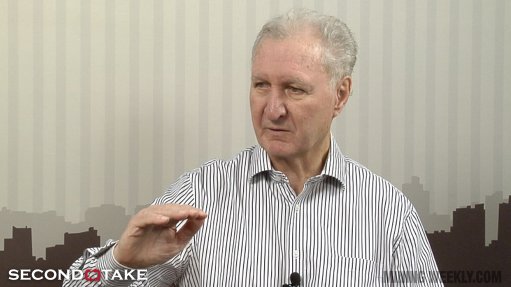
Rockwell Diamonds CEO John Bristow comments on consolidation impetus for diamond juniors.