GOLD 1539.22 $/ozChange: -19.23
PLATINUM 1433.00 $/ozChange: -13.50
R/$ exchange 8.32Change: -0.12
R/€ exchange 10.58Change: -0.06
 
We have detected that the browser you are using is no longer supported. As a result, some content may not display correctly.
We suggest that you upgrade to the latest version of any of the following browsers:
         
close notification
powered by
Advanced Search


Home
 
Multimedia


podsafm_15012010
GET SELECTED AUDIOCLIP
Embed
This article's audio Download (6.17mb)


15-01-2010 (On-The-Air)
 
15th January 2010
TEXT SIZE
Text Smaller Disabled Text Bigger
 

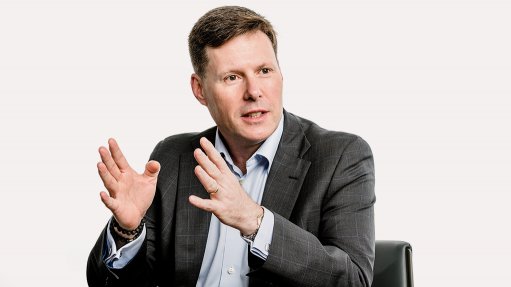
Every Friday morning, SAfm's AMLive's radio anchor Tsepiso Makwetla speaks to Martin Creamer, publishing editor of Engineering News and Mining Weekly. Reported here is this Friday's At the Coalface transcript:

Makwetla: Eskom may invite the private sector to take up a far larger shareholding in the proposed new Kusile power station in Mpumalanga.

Creamer: The South African government and the board of Eskom has already agreed that the private sector can take up 30% of the new Kusile coal-fired power station in Mpumalanga. But, because of this funding gap that Eskom still has even though it is proposing this 35% increase, it would like to consider making a greater percentage available to the private-sector up to 49%.

The South African government hasn't given permission nor has the board of Eskom given permission to actually do that, but they have said that they will allow them to probe this possibility and can start looking into it, which is what they are doing now.

So, this would be the biggest public private partnership in South Africa's history, because it will mean an investment by the private-sector of up to about R70-billion, because we are talking about R142-billion to R150-billion power station here.

A lot of people are saying that Eskom are using the wrong costing model. We saw a study come out from Genisis saying that Eskom shouldn't be asking for a 35% they should be asking for 25% because they used the wrong costing model instead of using the historic costing model, they have used modern equivalent asset replacement type costing model.

So, the jury is still out and we know that the hearings are taking place now. We will know by the end of February what that determination is and then it will be enforced by April 1.

Makwetla: Seeing that it is 2010, a lot of people have their hopes up, but job-creation a big deal this year and you say R6-billion worth South African platinum project is on hold because of deep divisions within the near-mine community.

Creamer: It hurts me when projects don't go ahead, because there are a lot of youngsters standing by ready for jobs. The particular project I am talking about is the Bakubung project close to Sun City.

It should have actually been producing know, but there were funding issues. Now, social risk has entered the picture, because that what we thought was a single community shareholding and it is big shareholding giving the empowerment status to this Bakubung project being done by Wesizwe Platinum.

You suddenly have that community split in two and the shareholding split in two. We saw from the extraordinary shareholders meeting that took place that this was pretty raucous if not hostile between the two community factions.

Now, this adds a dimension of social risk at a time when investors are already having funding problems, so do they go in. There wasn't much geological risk with this project that Wesizwe were doing near Sun City, there isn't much mining risk.

There was a funding issue and they were going to do it in phases, but now we have a social risk and I think that the community shouldn't bring this upon themselves, because they are actually denying possibilities of wealth creation and job creation.

The Bakubung community was hoping to emulate the Bafokeng nearby, who have done amazing wealth and job creation activities with the platinum assets they had. We thought the Bakubung Ba-Ratheo community would follow suit, but know we see them split.

Makwetla: What a pity. South Africa's big radio astronomy project in the Northern Cape is set to make big strides in 2010. Tell us all about it.

Creamer: We have got to make big strides in 2010 because we are competing against the Australians. South Africans are fighting for this multi-billion rand foreign investment in the Square Kilometre Array (SKA) and the only two on the short list now are the Australians and ourselves.

South Africans have declared a radio astronomy reserve. It is about 14 000 hectares in the Northern Cape and we are going ahead with the Meerkat project there which is a radio astronomy, which is the study of celestial bodies.

We have now actually been receiving the signals on those dishes and converting them through computerisation.

The system is working and gradually we are moving ahead there and we are going to have our own radio astronomy hub come what may. But, of course, they are trying to do it in such a way that we do win this wonderful big SKA award.

At the same time the spin-off is great, because we see 199 bursaries being awarded to students for radio astronomy and all the other engineering activities related to radio astronomy. We also see a whole lot of new seats at universities.

So, this is going to be an area in which South Africa can create some jobs, a lot scientific activity and engineering activity and hopefully eventually beat of the Australians in 2011, when they select the site.

Makwetla: Thanks very much. Martin Creamer is publishing editor of Engineering News and Mining Weekly, he'll be back with us at the same time next week.


Edited by: Creamer Media Reporter