GOLD 1729.34 $/ozChange: -7.43
PLATINUM 1657.00 $/ozChange: 11.00
R/$ exchange 7.58Change: -0.03
R/€ exchange 10.04Change: -0.13
 
We have detected that the browser you are using is no longer supported. As a result, some content may not display correctly.
We suggest that you upgrade to the latest version of any of the following browsers:
         
close notification
powered by
Advanced Search


Home
 
World News
 
South America
 
 
DIVERSIFIED MINERS
South African mining groups doing well in South America
 
6th November 2009
TEXT SIZE
Text Smaller Disabled Text Bigger
 

South America is a continent whose richness in natural resources became legendary through myths such as El Dorado or the Emerald Mountain. Neither of these ever existed, of course, but today the continent produces antimony, bauxite, coal, cobalt, copper, gold, iron-ore, lead, manganese, molybdenum, nickel, phosphates, platinum, silver, tantalum, tin, titanium, tungsten, uranium, zinc and zirconium, plus oil and gas, as well as a wide range of precious and semiprecious stones.

The continent today comprises the countries of Argentina, Bolivia, Brazil, Chile, Colombia, Ecuador, Guyana, Paraguay, Peru, Surinam, Uruguay and Venezuela, as well as the French territory of Guiana. Often lumped together in the popular mind, these countries are actually very different from one another. True, Argentina, Bolivia, Chile, Colombia, Ecuador, Paraguay, Peru, Uruguay and Venezuela all speak Spanish, but they don’t pronounce the language in the same way and each is very distinct from the others.

With its riches, South America has, unsurprisingly, long attracted foreign investors seeking mining opportunities. These have included South Africans. Today, three major companies which are listed in whole or in significant part on the JSE are actively mining in Africa’s western neighbour continent. These are Anglo American, AngloGold Ashanti and Gold Fields.

Anglo (South) American

Of these, Anglo American has the biggest portfolio of assets in South America. “We have been in South America for more than 30 years,” points out Anglo American media relations head James Wyatt-Tilby. “We have a number of very significant and successful businesses there, in copper, iron-ore, nickel and coal. South America is a very large part of our global business and future prospects and we’re investing several billion dollars in new projects in Brazil, Chile and Peru.”

Indeed, in her address to the Brisbane Mining Club last month, Anglo American CEO Cynthia Carroll specifically highlighted three of the group’s projects in South America, saying that the “key Minas-Rio iron-ore and Barro Alto nickel developments in Brazil and the Los Bronces copper expansion in Chile are all well placed on their industry cost curves, have long resource lives and are on track to enter production from 2011 onwards in what is expected to be an environment of growing commodity demand”.

Anglo American is active in Brazil, Chile, Colombia, Peru and Venezuela.

In Brazil, it holds 100% of nickel producer Codemin, 100% of ferroniobium producer Catalão, 73% of phosphate and phosphoric acid producer Copebrás and 100% of Anglo Ferrous Brazil. Anglo Ferrous Brazil, in turn, owns 69,2% of the Amapá iron-ore-mining operation and 99,4% of the Minas-Rio iron-ore project. (However, in late October, the group announced it would divest from Catalão and Copebrás).

In Chile, Anglo American owns 44% of the Collahuasi copper operation, 100% of the Chagres copper smelter, 100% of each of the El Soldado, Mantos Blancos and Mantoverde copper mines, as well as 100% of the Los Bronces copper (primary product) and molybdenum (by-product) mine.

In Colombia, the group has a 33% share in the Cerrejón coal operation.

In Peru, it has two projects under development, with an 81,9% share in the Quellaveco copper project, and 100% of the Michiquillay polymetallic project, which would have copper as its primary product and gold, molybdenum and silver as the by-products.

In Venezuela, Anglo American holds 91,4% of the Loma de Niquel ferronickel operation and 25% of the Carbones del Guasare coal- mining company.

The group has classified three of its South American programmes as “world-class strategic growth projects”. These are the Minas-Rio iron-ore project, the Barro Alto nickel project (both in Brazil), and the Los Bronces copper expansion project, in Chile.

Minas-Rio, which Anglo American bought from Brazilian iron-ore-miner MMX in 2007, is so named because the iron-ore will be mined in Minas Gerais state and exported from Rio de Janeiro state. The acquisition of Minas-Rio and Amapá together cost Anglo American $5,5-billion.

Minas-Rio is expected to start production in the second quarter of 2012 and its first phase will have an annual production capacity of 26,5-million tons; however, planning is already under way to increase this to 80- million tons yearly by 2015. Since buying Minas-Rio, Anglo American geologists have been able to increase the resources from 1,2-billion tons in 2007 to 4,6-billion tons today, with potential for more.

The expected iron grade will be more than 68%, which will make pellets from the project top-quality products in an industry that, worldwide, is forecast to suffer from declining ore grades. The iron-ore will be conveyed in slurry form along a pipeline to the new port of Açu, construction of which is well advanced.

Barro Alto falls under Anglo American Base Metals, and is now more than 70% complete, on course for start-up in the first quarter of 2011. Anglo American acquired the mineral rights for Barro Alto in 2002 and construction started in 2007. The $1,8-billion project is expected to achieve full production in 2012 and average annual production over a 26-year life-of-mine is expected to be 36 000 t of nickel. (The mine will actually produce 41 000 t/y of nickel for each of its first five years of operation, and will boost Anglo American’s total global nickel production to 60 000 t/y in 2012).

It has the second-lowest capital density (that is, estimated capital expenditure divided by average annual nickel production) among new nickel projects. The lowest capital density is Vale’s Onça Puma at $20,4/lb, and Barro Alto is close behind, at $22,7/lb; in third place is BHP Billiton’s Raventhorpe at $27,8/lb, followed by Xstrata and SMSP’s Koniambo at $28,7/lb, Vale’s Goro ($31,9/lb) and Sherritt and partners’ Ambatovy ($34/lb).

Los Bronces comprises an operational open-pit mine, producing 236 000 t of copper and 2 600 t of molybdenum last year, with reserves of 2,4-billion tons of ore at a grade of 0,51% copper, resulting in 12,2-million tons of contained copper, giving a mine life of 30 years, plus two major prospects. The first of these is designated San Enrique Monolito, and is immediately adjacent to Los Bronces, lying south-south-east of the openpit, while the second is called Los Sulfatos and is 6 km south-south-east of Los Bronces.

San Enrique Monolito has estimated inferred resources of 900-million tons at 0,81% copper, giving 7,2-million tons of contained copper, but total resources could actually reach 3,5-billion tons at grades of between 0,65% and 0,75% copper; 56 km of exploration drilling is proposed for next year.

Los Sulfatos has estimated inferred resources of 1,2-billion tons at 1,46% copper, giving 15,5-million tons of contained copper; 22 km of exploration drilling has been completed and an 8-km exploration tunnel is being excavated, at a cost of $77-million. This tunnel is due to be completed in 2011, and thereafter some 100 000 m of drilling will be carried out, with the aim of finishing conceptual and pre-feasibility studies by the end of 2013.

But Los Bronces itself has resources in addition to its reserves. These resources amount to 4,1-billion tons at 0,39% copper, giving 16,1-million tons of contained copper.

Anglo American is currently executing a $2,4-billion expansion programme which will make Los Bronces the fifth-largest copper mine in the world. The expansion will start up in the last quarter of 2011 and achieve full production in 2012, and will see Los Bronces’ production roughly double, to 490 000 t/y of copper for the first three years, and an annual average of 415 000 t of copper over the first ten years, as well as 5 400 t/y of molybdenum.

Golden Opportunities

AngloGold Ashanti was in origin the gold-mining arm of Anglo American, but is now a completely separate and unrelated company. “South America is extremely important to us,” affirms AngloGold Ashanti public affairs manager Alan Fine. “That continent last year accounted for 11% of the gold ounces we produced.

“We have solid operations in Argentina, we have fairly major extension projects in Brazil – Brazil has the potential for significant growth – and we have made very promising discoveries in Colombia,” he explains. “In Colombia, we have made the largest find of new gold by anyone in the past ten years.

“South America is obviously a very important place to do business for us,” he adds. “South America is an area we focus on because we believe we are equipped to manage the challenges there.”

Currently, in Argentina, AngloGold Ashanti has a 92,5% stake in the Cerro Vanguardia operation, which produces both gold (primary product) and silver (by-product). In Brazil, the company owns 100% of AngloGold Ashanti Brasil Mineração (previously known as Morro Velho) and 50% of Serra Grande. In Colombia, the company has made two signifi- cant discoveries, at La Colosa and at Gramalote. AngloGold Ashanti holds 100% of the La Colosa project and has 49% of the Gramalote project (its partner in Gramalote is Vancouver-based mining and exploration company B2Gold).

Regarding Cerro Vanguardia, the com- pany’s partner is this operation is Formicruz, which is owned by the province of Santa Cruz, within which the mine lies. Cerro Vanguardia comprises numerous small openpits with high stripping ratios, and gold output last year was 166 000 oz (of which 154 000 oz was attri-butable to AngloGold Ashanti), down from 220 000 oz in 2007. Total cash costs were $608/oz in 2008, sharply up from $261/oz in 2007, while production costs were $757/0z last year, nearly double 2007’s $394/oz.

The mine was hit by a number of breakdowns in the plant, reduced throughput of tonnage, and poor grade recovery. In response, the group made changes in Cerro Vanguardia’s management, which have led to better plant reliability and improved grade recovery. Total cash costs are expected to fall to between $410/oz and $430/oz and gold production attributable to AngloGold Ashanti is forecast to increase to 160 000 oz for this year.

The company is completing a four-year brownfield exploration programme at Cerro Vanguardia, which started in 2006. This is aimed at establishing the life of the mine and the delineation of the shallow high-grade mineral resource. The result has been the adding of 300 000 oz of gold and eight-million ounces of silver to the mine’s mineral resources. This year has also seen the start of a project to determine the potential for underground mining and heap-leach treating of low-grade material at the mine.

In Brazil, the South African group’s wholly owned AngloGold Ashanti Brasil Mineração operates the underground Cuiabá, Córrego do Sitío, Lamego and São Bento mines, all near the city of Belo Horizonte, in Minas Gerais state. An expansion project at Cuiabá was completed last year, while Lamego is a new development, which only recently entered production. São Bento, which is in the vicinity of Córrego do Sitío, was bought off Eldorado Gold last December because of the synergies and increased production it offered with the latter project.

In total, Brasil Mineração produced 320 000 oz of gold last year, up from 317 000 oz in 2007, at total cash costs of $300/oz (up from $233/oz in 2007) and total production costs of $432/oz (as against 2007’s $344/oz). Brownfields exploration projects are under way ($15,8-million was spent on exploration last year, adding another 425 000 oz to the reserves) and the group is studying the reopening of the mothballed Raposos mine.

Serra Grande lies in the Brazilian state of Goiás, near the city of Crixás, and AngloGold Ashanti’s partner in this operation is Kinross Gold. The South African company manages the operation, which comprises two established underground mines, Mina III and Mina Nova, an openpit at Mina III and the new Palmeiras mine.

Total Serra Grande gold production last year was 174 000 oz (87 000 oz attributable to AngloGold Ashanti), down from 182 000 oz (91 000 oz attributable) in 2007, with total 2008 cash costs of $294/oz (up from $263/oz in 2007) and total production costs last year of $394/oz (2007: $351/oz). The production decline was due to a reduction in the tonnage of ore treated at the underground operations, and this was also mainly responsible for the rise in total cash costs, along with the strengthening of the Brazilian currency against the dollar, and inflation.

Palmeiras is expected to produce 16 000 oz/y of gold from 2010, its first full year of production. The company is undertaking an “aggressive” brownfield exploration programme around Mina III and Mina Nova.

Colombia is where AngloGold Ashanti is currently concentrating its greenfield explor-ation projects in the Americas. The company entered Colombia in 2003, becoming the first to create a systematic grassroots exploration programme in that country.

The South African group has to date staked 13,1-million hectares of exploration claims in Colombia, of which 11,2-million have been systematically explored and 10,4-million hectares have been relinquished; 423 mineral contracts are currently active, covering just over 825 000 ha. AngloGold Ashanti hopes to complete first-stage exploration on its remaining 2,7-million hectares of claims by the end of this year.

The two big discoveries, La Colosa and Gramalote, together have estimated reserves of more than 12-million ounces. La Colosa lies in the department of Tolima, quite near the town of Ibague, some 150 km west of the capital city of Bogotá, and has an estimated inferred resource of 12,3-million ounces. Gramalote is located some 80 km north-east of the city of Medellin, in the department of Antioquia, and has an inferred resource of 2,39-million ounces of gold.

Crown Hill

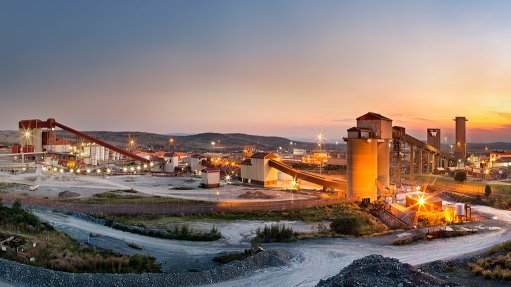
Gold Fields is much newer to South America than either Anglo American or AngloGold Ashanti, and currently all its activities on the continent are concentrated in one country – Peru. Here, the South African gold-miner has both an operational mine and exploration projects. The mine, Cerro Corona (which translates into English as Crown Hill), is brand new, having completed construction in July 2008.

“The last year has been an important year for us in South America, specifically in Peru,” affirms Gold Fields spokesperson Julian Gwillim. “We completed the commissioning and ramp-up of the Cerro Corona mine, which went particularly smoothly, with the mine achieving steady-state production during the last financial year. This is a significant achievement when one considers that, prior to this project, Gold Fields had limited operating experience in South America, and that the Cerro Corona mine site is in a geographically challenging and remote location.”

Cerro Corona is actually owned by Gold Fields La Cima SA, a subsidiary of Gold Fields (the letters ‘SA’ are equivalent to (Pty) Ltd in South Africa), and lies in the north of Peru, near the village of Hualgayoc, some 80 km by road north of the city of Cajamarca, in the department of Cajamarca. To the parent group’s delight, Cerro Corona took second place in the openpit category in Peru’s National Mining Safety Contest (organised by the Peruvian Mining Safety Institute).

The mine cost $545-million to build. In its first nine months of operation, it produced 105 000 oz of gold. A bimetallic copper and gold mine, it also produced 23 947 t of copper.
Converting this copper production, at an average copper price of $4 115/t and an average gold price of $875/oz, into its equivalent in gold, gives a total equivalent gold production of 219 000 oz, of which 218 000 oz was sold.

In all, during these nine months, Cerro Corona mined 9,9-million tons, of which five-million tons was ore and 4,55-million tons was milled, resulting in an output of 119 000 t of concentrate. Revenue came to $184-million, costs – including gold-in-process movements – were $82-million and total cash costs were $369/oz (based on equivalent ounces).

The result was an operating profit of $102-million and an operating margin of 55%.

Now the company is looking for further opportunities in Peru, and its subsidiary, Minera Gold Fields Peru, is in partnership with local mining group Buenaventura (Peru’s largest listed mining company) in the Chucapaca exploration project, which lies in the far south of Peru, in the department of Puno, near Lake Titicaca. Chucapaca is an “advanced drilling exploration project”, explains Gwillim, “where recent drilling intersected significant gold with copper grades, which has resulted in an aggressive resource delineation programme on this discovery”. The importance of Chucapaca is highlighted by the fact that it is one of only three advanced drilling projects being conducted by Gold Fields worldwide at the moment.

Edited by: Creamer Media Reporter
FULL Access to Mining Weekly and Engineering News - Subscribe Now!
Subscribe Now Login


Hide Comments  
 
Readers Comments
 
image image
While Anglo Gold Ashanti do well in South America, there are those who are not doing so well. Afro-descendant and Indigenous communities in Colombia are about to loose their ancestral territories where they have practice mining for centuries. The Colombian government, in violation of Colombian norms and international measurements, including the ILO 169 Convention, and in violation of economic and territorial rights of the ethnic groups, has authorize licenses and concession directly to Anglo Gold Ashanti and indirectly through different groups and individuals, subcontractors of the Anglo Gold Ashanti. Only in the small area of the Community Council of la Toma in the department of Cauca, municipality of Suarez, more than 7000 families will be affected, as they will loose their principal way of subsistence: mining. A thousand and 52 families in that community are already facing eviction from their ancestral territories, in order to permit a foreigner the right of exploitation of the gold that feed those families. By the Law 70 of 1993, the 169 ILO Convention and by Colombian Constitution, those communities should be consulted previous concession of those permits. As the members of those communities fight for their rights to be respect, paramilitary groups, defending foreign capital interest, have threatened their lives. Today, the members of La Toma Community Council, that comprises five villages, are under death threat for defending their right to their land, their right to continue practicing their ancestral productive practices, and their right to a dignified life. Anglo Gold Ashanti, holding hands with Colombian government, are responsible for the threatening situation of many other communities where they expect to expand their profitable goals.
image image 
image
Charo Mina Rojas on 10th November 2009