JOHANNESBURG (miningweekly.com) -– It's raining equity capital for the JSE-listed Pallinghurst which on Monday secured $250-million from the Dutch, another $50-million from the Singaporeans atop last month's $100-million, and is assured of backing for Platmin's latest $250-million equity raising.
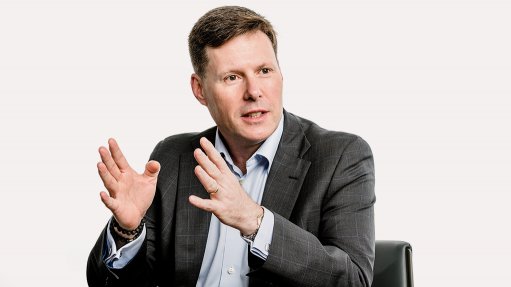
South African Economic Development Minister Ebrahim Patel and Dutch Ambassador to South Africa Rob de Vos flanked Pallinghurst CEO Arne Frandsen at the media conference as he outlined the $400-million – R3-billion – of foreign, sovereign long-term equity commitments into the South African mining sector.
De Vos revealed that his very own pension money is invested in the leading Dutch asset manager Algemene Pensioen Groep (APG), which has committed $250-million of equity capital to Pallinghurst after "very thorough due diligence on South Africa, its mining industry and Pallinghurst".
"We're seeing a new type of partnership between capital, countries and producers which I think is built on a solid foundation. The investments are not derivatives nor ‘funny' instruments, but hard old ‘greengrocer' equity that's being put to work," Frandsen said.
"We're talking about a blue-chip country and the pensions of four million Dutch workers being brought into South Africa, where it's going to be invested in a number of mining ventures.
"The capital that has been raised is equity capital. We do not hand over our keys to any bank. We run our mines on behalf of the owners, be they Dutch pensioners-to-be or big institutions. It is hard equity that is being put to work in an old-fashioned way. All our operations are debt free and unhedged," Frandsen told Mining Weekly Online.
More than $200-million of the ten-year APG commitment was earmarked for resources investments in South Africa, where it had the potential to create 400 sustainable jobs. Pallinghurst would manage and invest the capital on APG's behalf.
"If you talk of global village, then that metal will be sent to China, where it will be used in the production of cars and knives and forks that will be sent to the US, where it would be consumed," Frandsen said.
As a first investment, APG would apply for a $50-million allotment in the upcoming equity placement by Pallinghurst's Platmin and the company's steel-feed platform was another likely core area of investment for the APG funds.
The APG investment represents the second recent commitment by a long-term blue chip foreign investor into Pallinghurst and its platinum-mining company Platmin, following the $100-million committed by the Singapore sovereign wealth fund Temasek in March.
Temasek on Monday announced it would apply for an additional $50-million allotment in TSX- and JSE-listed Platmin's upcoming equity raising, increasing its commitment in Platmin - "and therefore South Africa" - to $150-million.
Platmin CEO Tom Dale said that, of the $350-million that the 1 050-employee Platmin had announced it would be raising, $200-million had already been secured ahead of the company's international road show to raise the balance of it.
Moreover, the equity raising was being accompanied by the prices of both platinum and palladium beginning to rally strongly after the global crisis.
Pallinghurst chairperson Brian Gilbertson could not be at the media conference because of the impact of the Iceland volcano fallout on international flights.
Frandsen said that Pallinghurst wanted to be relevant in platinum and in steel-feed materials such as manganese and iron-ore.
"We will develop the entire region north of the Pilanesberg in a rational and economically sensible fashion in partnership with all stakeholders, and labour will have a seat at the high table as we lay out our plans.
"We will not be dictated to by farm fences in developing the region, but we will develop it in accordance with the manner in which Mother Nature has deposited the platinum ounces into the ground. We are very fortunate to have an equal partnership with the local community, which allows us to do this.
"When it comes to manganese, you can repeat what I have said about platinum. Eighty per cent of the world's seaborne manganese is in the Kalahari Basin and we need, as a country, to be very clever in getting that out. That will be an absolutely strategic area of focus. You can't make steel without manganese. For generations to come, people around the world will use cutlery that contains manganese from the Kalahari Basin.
"There is no other Kalahari Basin on this planet and there is no other Bushveld Igneous Complex and it is both a responsibility and an opportunity for all of us to ensure that we develop those two areas to the benefit of the country and the investors involved," Frandsen told Mining Weekly Online.
In the past 18 months, Pallinghurst has invested more than $500-million of mainly foreign funds into the South African mining industry.
"We will continue to focus on attractive, sustainable and socially responsible investments, which will not only provide our investors with superior returns but also benefit all our stakeholders, " Frandsen said.
The $250-million was described as being "initial" from an APG, which has €240-billion worth of financial "firepower".
Describing the investment as "a first, very important step", Frandsen said that capital was available for the right opportunities in the right investment environment and that the investments in South Africa were a first for both APG and Temasek. In the teeth of the global economic crisis, he said that Pallinghurst had managed to raise more than $1,5-billion that was committed for at least ten years.
De Vos said that pension-fund security would be an election issue when the Dutch went to the polls on June 9, which indicated the confidence that the country had in the future of South Africa.
"We will contribute to South Africa's new industrial policy, which aims to bring South Africa on a higher growth path," De Vos added.
Patel noted that Pallinghurst had raised $400-million from some of the world's most conservative sources of funding that needed to be sure that the funds were secure and that the country of investment had the right mix of policies.
"Not only is it a vote of confidence in South Africa, but it has also identified an enormous pool of investment - pension fund money - that the South African economy can draw on globally," Patel added.
He said that the platinum sector currently employed 179 000 workers, which represented nearly 2% of total formal-sector employment and had overtaken gold mining as the largest mining employer of labour in South Africa.
There was also recognition of the potential of manganese mining to create employment and South Africa's manganese reserves were in excess of the country's share of global production, which presented an opportunity that awaited development.
He encouraged Pallinghurst to work closely with organised labour to develop a long-term partnership for growth and development.
"We see exciting opportunities in downstream beneficiation and we are working to develop the basis for a sustained post-recessionary growth path, which requires us to find very practical ways that our economy becomes more labour absorbing and brings millions of unemployed persons into decent work," Patel said.
Nine labour-absorption opportunities had been identified: infrastructure development, environmental protection, manufacture, the knowledge economy, rural agriculture and agri-processing, tourism, the social economy, public-sector growth and the regional and continental economy.
Patel said that mining was an important part of catalysing downstream activities and was a key user of the new energy and transport infrastructure that was under consideration and construction in South Africa, at an investment of more than R840-billion.
A mining supply park, which would function as a logistics, technology and innovation hub, was being established in North West province to provide mining suppliers and vendors with a manufacturing and marketing platform.
To subscribe to Mining Weekly's print magazine email subscriptions@creamermedia.co.za or buy now.