GOLD 1568.64 $/ozChange: -23.17
PLATINUM 1448.00 $/ozChange: -11.50
R/$ exchange 8.33Change: 0.00
R/€ exchange 10.55Change: 0.09
 
We have detected that the browser you are using is no longer supported. As a result, some content may not display correctly.
We suggest that you upgrade to the latest version of any of the following browsers:
         
close notification
powered by
Advanced Search


Home
 
Multimedia


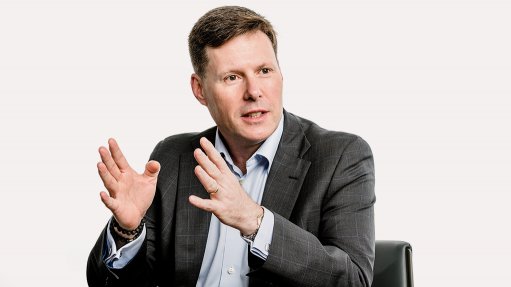
Mintek GM for business development Dr Roger Paul and GM for technology Peter Craven discuss the trend’s in the mining industry that are driving technology development. Camerawork: Nicholas Boyd. Editing: Darlene Creamer.
This video is licensed under a Creative Commons License
GET SELECTED VIDEO
Embed
Selected Video Download (7.3mb)


Challenges driving technology development
 
8th July 2011
TEXT SIZE
Text Smaller Disabled Text Bigger
 

Trends such as reduced energy and water use and, increasingly, falling grades of ore in the mining industry are driving the need for further development of technology, says State-owned research company Mintek GM for business development Dr Roger Paul.

Many of the world’s remaining strategic ore resources are located in arid, remote regions, such as in Africa, where the operations do not have sufficient access to water and energy for operations and can impact on the resources of the mines’ surrounding communities.

Further, it is becoming increasingly important for the mining industry to reduce its energy and water use, owing to the shrinking supply of these resources and environmental concerns.

Mintek GM for technology Peter Craven adds that a challenge for the mining industry is the ability of companies to use the limited available energy and water to mine ore resources.

“If a mine is able, for example, to identify and separate 20% or 30% of crushed rock that is barren and classified as waste, from crushed rock that contains high proportions of ore, subsequent energy or water use is reduced by about 20% or 30%,” Paul tells Mining Weekly.


In collaboration with Germany-based ore-sorting technology company Commodas-Ultrasort, Mintek is facilitating the development of fast, high-resolution cameras and other sensor systems that, with the appropriate software programming, can differentiate and separate valuable rock from waste rock.

Mintek also cooperated with Russia-based chemical sorting firm Rados through the establishment of an ore-sorting pilot plant at Mintek’s premises, in Randburg, in October last year. The test facility holds a full-scale production plant for X-ray chemical sorting tests on an X-ray fluorescence sorter.

The final commissioning phases of the unit have been completed and further development and improvements are currently under way, says Paul.

Craven points out that energy and water use in processing can be reduced significantly by these dry-sorting methods which reject most waste rocks.

Owing to the development of, besides other innovations, advanced computer processing systems, reliable and accurate ore-sorting technology, specifically for lower-grade ore, has emerged.

Mining companies are increasingly using ore-sorting technology to economically extract and treat lower-grade ore deposits in a simplified process.

The average head grade of almost any mineral component is decreasing, resulting in many unmined low-grade ore mineral depos- its being sought as valuable mineral deposits, says Craven.

Also, South Africa’s energy sustainability plan, through the Integrated Resource Plan, is committed to producing nuclear energy, which will require the increased extraction of uranium. The country will need to examine options to economically extract uranium from low-grade ore.

South Africa has the fourth-largest uranium reserves in the world; however, owing to the fact that these large ore reserves are of a lower grade than those of countries with smaller uranium reserves in richer pockets, South Africa is only the ninth-largest uranium producer.

The high cost of uranium, which is currently between $50 and $60 a pound, up from between $5 and $10 a pound in the 1980s and 1990s, is also a driver for extracting uranium more economically.

Mintek’s Metrix technology, which completed testing in February, shows that uranium can be recovered economically at concentrations as low as 90 ppm. The sizable pilot plant ran for two months at gold-mining company Harmony Gold’s Virginia operations.


Meanwhile, owing to the negative environmental impact of cyanide during gold processing, a number of technologies have emerged to oxidise and destroy the cyanide, although this can be a costly undertaking.

Paul points out that the search for an alternative to cyanide is pointless, as a replacement is unlikely and may be no better for the environment than cyanide.

Mintek is focusing on reducing the use of cyanide, as well as measur- ing cyanide levels in effluent from the processing plant that could escape into the environment by improving its product, Cynoprobe.

A proto- type for low-level detection, which will add to the versatility of Cynoprobe, will be commercialised in the next six months.

This unit measures the cyanide concentration and controls the dosage of cyanide into leach tanks to ensure no under- or overdosing takes place.

Over the past six months, Mintek has been improving Cynoprobe, enabling its use in detecting free cyanide in ranges from 5 ppb to 10 ppb in effluent, Paul concludes.

Edited by: Henry Lazenby