GOLD 1568.62 $/ozChange: -23.19
PLATINUM 1448.00 $/ozChange: -11.50
R/$ exchange 8.33Change: 0.00
R/€ exchange 10.55Change: 0.08
 
We have detected that the browser you are using is no longer supported. As a result, some content may not display correctly.
We suggest that you upgrade to the latest version of any of the following browsers:
         
close notification
powered by
Advanced Search


Home
 
Most Popular Articles - Americas
 
 
IRON-ORE
Cash-pumping Kumba set to spend R4bn a year in ongoing iron-ore capex
 
23rd July 2009
TEXT SIZE
Text Smaller Disabled Text Bigger
 

JOHANNESBURG (miningweekly.com) – Cash-pumping JSE-listed Kumba Iron Ore (KIO), which reversed the global cutback trend and increased its production 14% in the first half of the year, expects to be spending capital in South Africa at a rate of R4-billion a year going forward, KIO CEO Chris Griffith told Mining Weekly Online on Thursday.

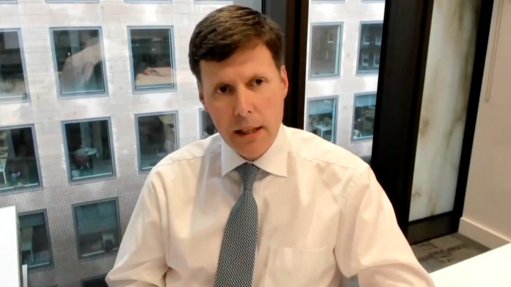
“Kumba has delivered its second-best set of financial results ever in the six months to June 30,” KIO CFO Vincent Uren declared, reporting a 33% revenue increase to R12-billion – a figure that is only R325-million off the company's record 2008 half-year achievement.

Investec analyst Kieran Daly calculated that, if the company continued selling four-million tons of iron-ore a month as it did in the second quarter of this year, it could theoretically sell all its production, as well as flatten its stockpile.

KIO GM: commercial Dr Timo Smit said that Kumba expected to sign additional long-term contracts in the second half of this year, but would avoid becoming over-committed and getting itself into an over-sold position.

Speaking to Mining Weekly Online exclusively after the company reported a 63% half-year increase in cash flow to R7,5-billion, Griffith said: “We will be spending R3,5-billion to R4-billion this year, increasing to R4-billion a year for the next few years.”

KIO returned R2,3-billion to shareholders in the first six months, R800-million of it to its black economic empowerment partner.

Moreover, the company’s flagship Sishen iron-ore mine was on track to produce 10% more iron-ore this year, after taking first-half production to 18-million tons – a 14% increase on the first six months of last year.

Export sales were 29% up in the first half to 17,1-million tons and strong Chinese demand reduced stockpiled iron-ore tonnage to 4,5-million tons, from 7,5-million tons at the start of the year.

The company cut costs by R700-million and notched up a profit for the six months of R4,3-billion, an increase of 23% from R3,5-billion in 2008.

“We're ramping up. We increased our production by 14% in the first half and we believe that we can still deliver the 10% increase in production at the end of 2009.

“We're going full steam ahead with the Sishen South project, a brand-new mine in the area of Postmasburg. It’s on time, it’s on budget and it’s employing a lot of people. We’ve already spent R1,6-billion and committed R3,6-billion,” Griffith told Mining Weekly Online.

On the role of the State-managed rail and port logistics in increasing sales to China to 80% of total sales, compared with 50% previously, Griffith commented: "Transnet has had a fantastic six months. They’ve been able to rail down to the coast all the volume that we’ve produced. They provided huge stockpile capacity at the Saldanha port that enabled us to find new customers. The shipping has been absolutely amazing," Griffith added.

However, he continued to caution that market conditions remained uncertain: "It’s still foggy out there; visibility's still not great", but  increasing steel production was continuing in China, as a result of the Chinese economic stimulus packages, and domestic production of iron-ore in China was down.

“These two together have created a 30% increase of imports into China,” he explained.

Simultaneously, destocking was coming to an end in Europe, Japan and Korea: “While there's not a lot of belief yet that Europe, Japan and Korea have turned around, we should start seeing an increase in sales into those regions. Although there's a bit of caution about business picking up, I think the second half is still looking pretty good," Griffith said.

KIO was continuing with its policy of returning excess cash to shareholders, and using bank debt to fund its capital-expenditure programme.

On increasing the dividend cover, Griffith said: “We’ve had a dividend cover of  between 1,1 and 1,4, but the board has taken the view that, with big capital spends in the next few years, and with the debt market not what it used to be, the dividend cover should be 1,5. We are very supportive of that process."

KIO's operating profit margin was 57% and mining margin 62% in the half year, which ongoing rand strength and lower iron-ore prices are poised to erode.

“But, at the same time, there will be the benefit of our increasing production and our revenue enhancement programmes, as well as cash containment,” Griffith said, adding that Kumba supported the benchmark pricing system because it provided annual stability.

“We believe benchmark pricing is very important, particularly for Kumba, because it enables us to create long-term relationships with our customers, which enable us to spend much more time working on the value-in-use of our product that can’t be done if sales are on a cargo-by-cargo basis.

“Because of that, we are able to demonstrate the very unique value of our iron ore in the steel mills of our customers and obtain small price premiums for our products.

“We have fantastic relationships with our Chinese customers, and have none of the problems that some other iron-ore suppliers are having. We've always had the benefit of being a strategic alternative supplier to the big three and we continue to see that,” Griffith said.

KIO has had a stockpile capacity of 0,6-million tons in China, but at the end of last year, itsmarketing team asked the Chinese port authority if it were possible to make more stockpile capacity available, and the Chinese port authority obliged by bulldozing down its own office to make way for what at one stage approached a stockpile of two-million tons.

Having that stockpile capacity enabled the company to ship material to China at a time of low $8/t-to-$10/t shipping rates.

ARBITRATION

The Faleme arbitration over the denial of exploration rights in Senegal was set down for the latter part of this year, as was Kumba's arbitration with ArcelorMittal.

“At this point in time, we're not doing any more exploration in Africa. We did have the two exploration joint ventures in Guinea, which we decided to terminate at the end of last year because the orebodies were not good enough.

“At this point, we have enough on our plate in South Africa and the opportunity to participate along the value chain by supplying iron-ore to our customers rather than just being a miner,” Griffith added.

Edited by: Creamer Media Reporter

To subscribe to Mining Weekly's print magazine email subscriptions@creamermedia.co.za or buy now.

Subscribe Now Login


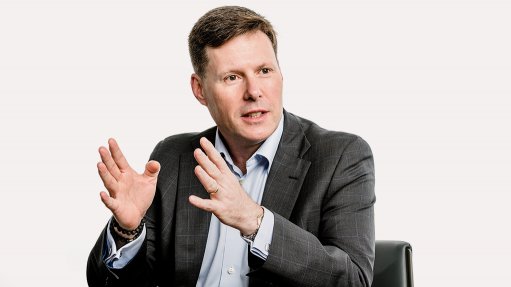
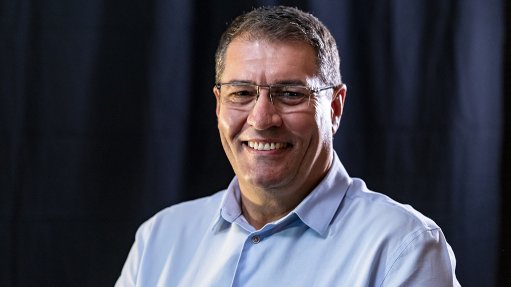
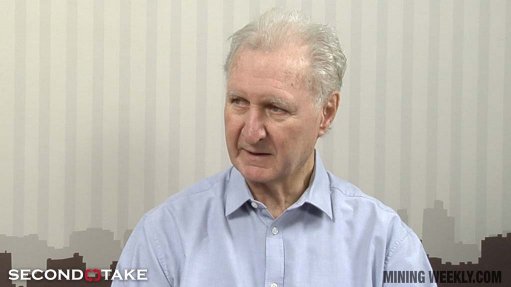
Kumba Iron Ore CEO Chris Griffith talks to Martin Creamer on the company’s capital expenditure. Cameraperson: Nicholas Boyd. Video Editor: Darlene Creamer.
This video is licensed under a Creative Commons License
GET SELECTED VIDEO
Embed
Selected Video Download (3.41mb)